Site · Newsletter
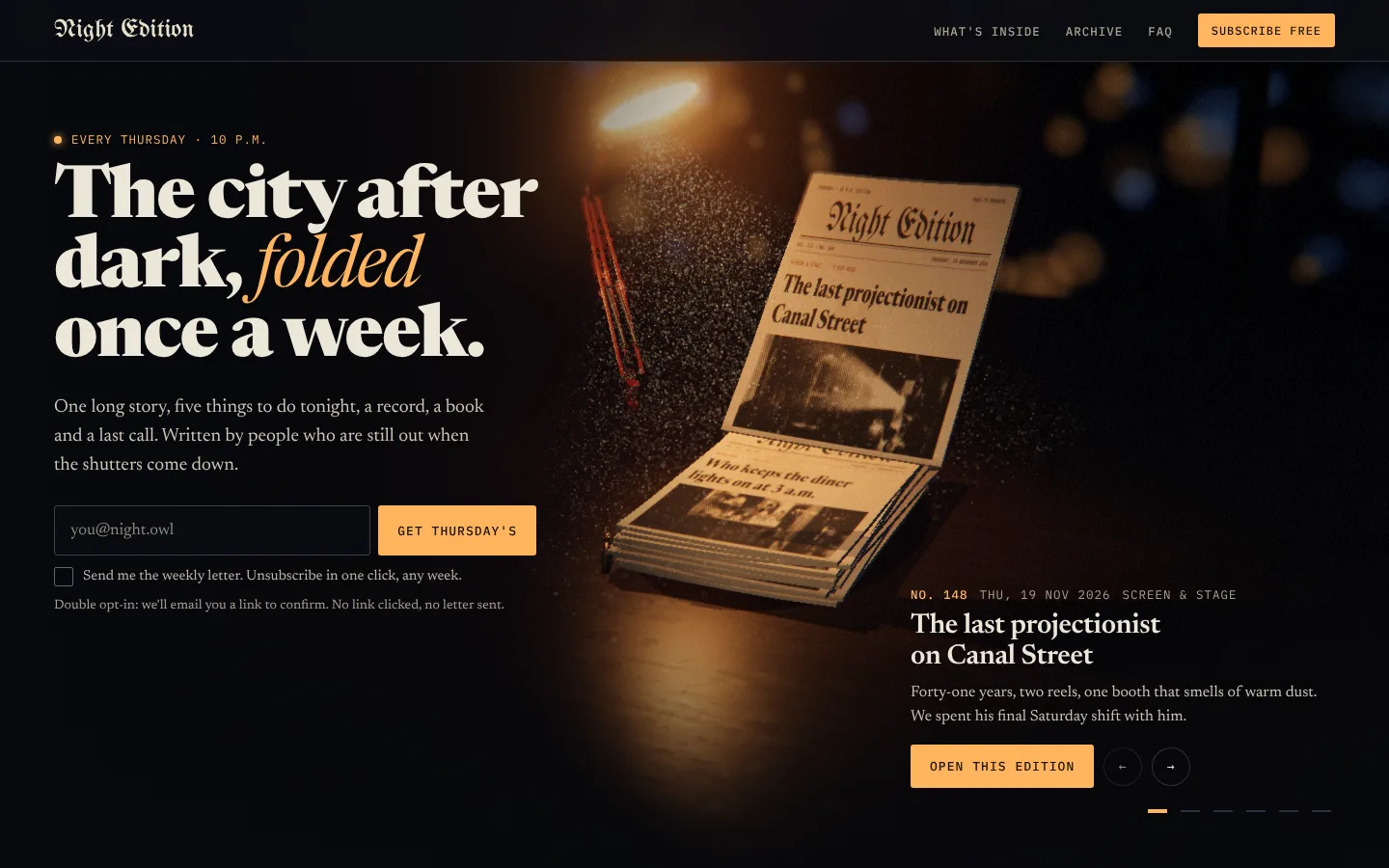
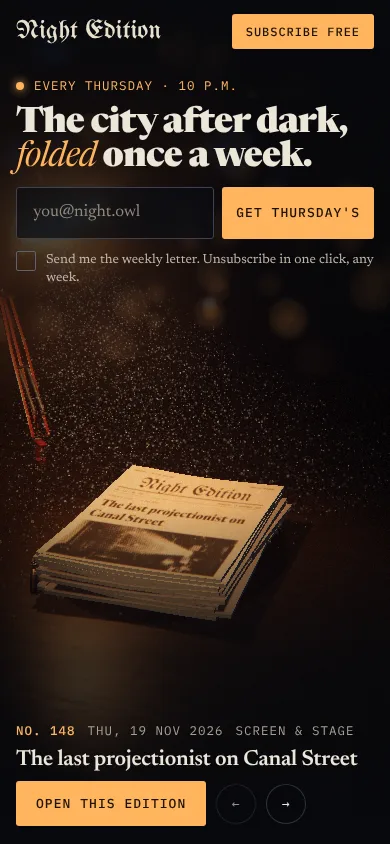
Night Edition Culture newsletter landing with a 3D stack of printed issues
A subscribe page where past issues sit as a 3D stack of printed editions you flip through, with an archive and a sign-up form for any newsletter platform.
What's in the prompt
- A full written spec: layout, tokens, every animation with its numbers, responsive rules
- The complete working code as the reference implementation, also as a ready-to-run .zip with every image, video and 3D model
- Accessibility, reduced motion and fallbacks already handled
- A “Make it yours” checklist so your site looks like nobody else’s
- Type
- Site
- Built with
- HTML, CSS, JS · three.js 0.170.0
- Prompt size
- 139 KB
- Tags
- newsletter landing page, substack, archive, three.js
- Updated
- 2026-11-26
Use it in three steps
- Copy the prompt with the button above.
- Paste it into your AI (Claude, Claude Code, ChatGPT, Cursor…) and add your edits.
- Launch the single
index.htmlanywhere: Cloudflare Pages, Netlify, GitHub Pages.
About the Night Edition design
Night Edition is a landing page for a fictional free weekly culture newsletter about the city after dark, sent every Thursday at 10 p.m. The palette is near-black ink, newsprint paper and one lamp amber. Newsreader sets the headlines and body, IBM Plex Mono the labels, and the blackletter UnifrakturMaguntia appears only in the masthead and Letters to the editor. The hero is the archive itself: twelve printed editions lie in a stack on a walnut desk under one warm arm lamp, with dust in the beam and city lights blurred behind. Each paper's front page is drawn at runtime from that issue's data, with masthead, headline, halftone photo, body columns and a fold crease.
Scrolling riffles the stack: each of the six newest editions lifts, turns its cover toward you, holds, then settles on a second pile while the camera dollies in. Clicking the presented edition flies it to the camera, its lower half swings out from under the fold, and a newsprint reader takes over with the same front page. Below come reader numbers and letters, an annotated anatomy of an edition with a countdown, a filterable archive of all twelve, an FAQ and a footer sign-up.
Good for
- Culture, arts and city newsletters: every paper in the stack is a real issue that opens to read
- Print zines moving online: the covers are drawn from issue data, so new editions need no new 3D work
- Weekly letters with a fixed send time: the countdown runs to the next Thursday 22:00 in local time
- Ghost publishers: the official signup embed is built in and loads only after consent
- Publications with a back catalogue: the archive filters by four topics and opens each edition in the reader
How Night Edition is built
- Front pages drawn on canvas. Each 768×1152 cover canvas (512 wide on lower tiers) is drawn after fonts load, with masthead, meta line, headline at 68px (56px for three lines), a multiplied halftone photo above the fold at y 576, three body columns below it and a brown crease.
- Riffle with a hold. Scroll progress maps to a target
f = k + .5 + .5·sign(s)·|s|^2.4, which plateaus on each edition, and a critically damped spring (k 70) follows it, so every paper lifts, holds facing you, then settles. - Unfold into the reader. A flap pivoted at the fold shows the lower half of the same cover; on open, the paper flies over 1.5 s to a pose fitted to 90% of the view height while the flap swings from π to 0, and the reader dialog opens at t = 1.
- Lamp-beam dust with bokeh. 26k, 12k or 5k points by tier sit mostly inside the light cone; each computes a circle of confusion from the presented paper's distance, and its alpha is scaled by (base/size)² so large blurred motes dim.
- Guarded post chain. Render, Bokeh depth of field (tier 2 only), a pass that turns any NaN or Inf pixel black, UnrealBloom at half resolution, output and a warm grade, so a bad pixel from a scanned prop cannot spread through the bloom.
Images, video and 3D
Two CC0 scanned GLB props (an arm lamp of 540 KB and a pocket watch of 380 KB) repacked with quantised geometry and WebP textures, CC0 walnut veneer maps at 1k, twelve night photos of a fictional city made with an AI image generator plus their 720px newsprint halftones (45° dot screen, 6px cells), and two posters captured from the live scene. To make your own, regenerate the twelve photos in one grade and re-run the halftone at a different screen.
Build it with Claude
Ask Claude for the full index.html. If WebGL or the three.js import fails, the page shows the poster and a 2D stack of six halftone cards, and the HUD, reader and forms keep working, so the preview can test them. Leave provider on demo and check the three form errors, the success panel, the Music filter count and the reader's Show in colour toggle.
Build it with Claude Code
Put the GLBs, walnut maps, posters and the ht/ and photo/ folders in assets/ and serve with npx serve. Ask Claude Code to set window.NE_CONFIG.provider to "ghost" with your ghost.siteUrl, or to "embed" with the code your newsletter platform gives you pasted into embedHtml, then confirm with request interception that nothing loads from the platform before consent. Set allowQueryOverride to false before launch, and never put an API key in the page.
Build it with ChatGPT
Ask ChatGPT for the page in parts, or in canvas: the HTML and CSS, the twelve editions' data, the cover canvas, the desk scene and lights, the riffle and unfold, the post chain, then the sign-up modes. A common follow-up is the paper UVs: check that the box's top face is remapped to the upper half of the cover and the flap to the lower half, or the unfolded page will repeat the headline.
ChatGPT guide →If it doesn’t work
- White streaks or a blown-out frame appear around the pocket watch: hide its glass meshes and add the NaN/Inf scrub pass before bloom.
- The covers render in fallback fonts: draw the cover canvases only after
document.fonts.ready, then mark the textures for update. - A pasted platform embed never appears: write each closing script tag in
embedHtmlas<\/script>, and re-create the scripts after inserting the snippet so they run.
Questions about Night Edition
Can I use Night Edition with my own newsletter platform?
Yes. In window.NE_CONFIG, set provider to "ghost" with your site URL to load Ghost's official signup embed, to "embed" and paste another newsletter platform's embed code, or to "custom" to POST to your own endpoint. Platform forms load only after the visitor ticks consent. API keys must never go in the page; keep them on your server.
What happens on phones and without WebGL?
Phones get a lighter rendering tier with fewer dust motes and a lower pixel ratio, and the hero copy fades out as the stack moves. Without WebGL, the poster shows over a 2D stack of six halftone cards that slide away as the visitor steps through editions, and every button still works.
Make it yours
This prompt rebuilds one exact design. If everyone ships it unchanged, the sites will look alike. Before you paste it, change these lines so the result is yours. Each change is one edit to the prompt; the structure and the interactions stay intact.
- Brand and beat. Swap "Night Edition" and its after-dark culture beat for your own newsletter (a food letter, a climbing zine, a local-politics weekly). Keep exactly 12 editions, 4 topics (each with 2–4 editions), a five-part issue anatomy and a weekly send time, so the riffle, the filters and the anatomy sheet stay balanced.
- Re-theme the signature object. Keep the stack, the riffle, the hold and the unfold, but change what is on the desk and how it is printed. For example: - zines on a risograph tray with two-colour covers; - recipe cards in a tin under a kitchen pendant; - postcards on a café table in daylight (swap the spot for a window key); - vinyl sleeves in a crate, where the unfold becomes a gatefold. Keep one hard key light, contact shadows and particles in the beam (steam, flour, chalk dust).
- Palette. Replace the ink, paper and lamp tokens with your own night or day trio. Keep text at ≥ 4.5:1 on its background and the accent only on CTAs, the kicker and the active state.
- Type pairing. Swap Newsreader + IBM Plex Mono + UnifrakturMaguntia for another trio: an editorial serif with optical sizes, a utilitarian mono, and one decorative masthead face used only twice. Redraw the cover canvas with the same fonts.
- Covers and photos. Regenerate the 12 photos in one consistent lens, light and grade for your beat. Re-run the halftone at a different screen (lines, a 15° angle, two-colour duotone) so your covers don't look like these.
- Props and set. Replace the walnut and the arm lamp with CC0 scans from your world. Keep one practical light source in frame and no more than two props.
- Copy voice. Rewrite every headline, dek, listing and letter in your voice, with named people, times and prices. No "unlock", no "elevate".
- Sign-up. Set
providerto your platform and fill in its fields using "Connect your newsletter", then rewrite the consent and double opt-in lines to match your real policy.
Tell your AI: "Build exactly as specified, but with these changes: …", then list your edits.