Section · Portfolio
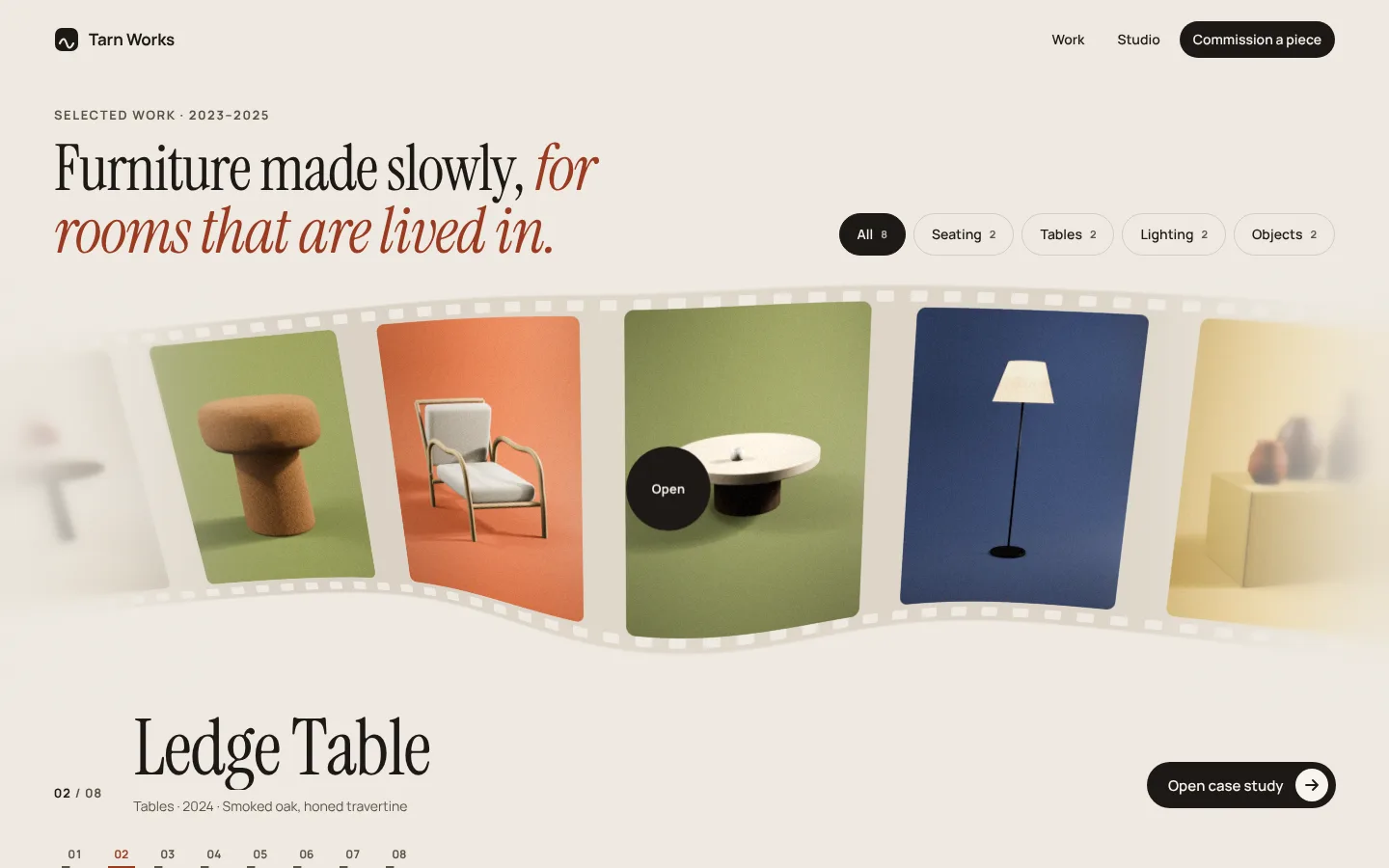
Tarn Works Work reel on a bending 3D film strip
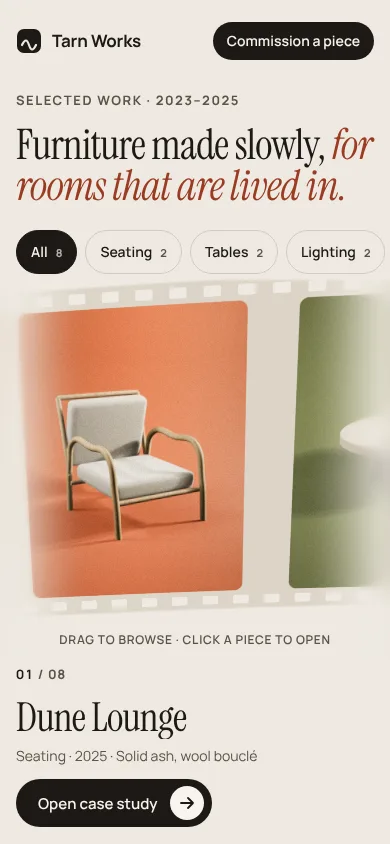
A furniture studio showcase where projects ride a perforated film strip that bends toward your cursor, filter by category and fly open into case studies.
What's in the prompt
- A full written spec: layout, tokens, every animation with its numbers, responsive rules
- The complete working code as the reference implementation
- Accessibility, reduced motion and fallbacks already handled
- A “Make it yours” checklist so your site looks like nobody else’s
- Type
- Section
- Built with
- HTML, CSS, JS · no libraries
- Prompt size
- 83 KB
- Tags
- portfolio, webgl, case study, showcase
- Updated
- 2026-11-26
Use it in three steps
- Copy the prompt with the button above.
- Paste it into your AI (Claude, Claude Code, ChatGPT, Cursor…) and add your edits.
- Launch the single
index.htmlanywhere: Cloudflare Pages, Netlify, GitHub Pages.
About the Tarn Works design
Tarn Works is a work showcase for a fictional furniture, lighting and objects studio, set on a warm bone field with dark ink and a single rust accent. Instrument Serif gives the headline and the rolling piece titles a gallery-label feel, and Manrope handles the controls. The eight pieces, from a bouclé lounge chair to a cork stool, are Blender Cycles renders from one studio set, so they read as one portfolio. The signature is a perforated paper ribbon that waves and twists through 3D space with the cards riding on it, and that bends toward the cursor, so browsing feels like handling a contact strip rather than scrolling a grid.
A visitor sees the headline, category chips and the ribbon drifting slowly across a full-bleed band. Hovering slows it, bulges the strip toward them and lifts the card under the pointer, while an ink cursor reads Open or Drag. The ribbon can be dragged with inertia, and the active piece's name rolls in letter by letter below it beside a counter and numbered ticks. Filters sink the cards into the strip and spring the new set back up. Clicking a card flies that exact image into a full-screen case study with specs, story and previous/next links before a studio section and a validated commission form.
Good for
- Furniture and product studios: each piece gets a ribbon card and a full case study
- Photographers: the prompt suggests re-theming the strip as 35 mm film with sprocket holes
- Architects and interior designers: the strip can become a measuring tape with tick marks
- Textile and craft studios: a selvedge fabric strip keeps the same wave and bend
- Small portfolios of 6–12 projects: the loop needs enough cards to overfill the band
How Tarn Works is built
- One ribbon function, three users. The same maths (y = 0.14·sin(0.62x + 0.35t), z = 0.34·sin(0.47x − 0.22t + 1.1), twist = 0.42·sin(0.41x + 0.28t + 0.6)) positions the WebGL vertices, the CSS fallback cards and the hit-test polygons, so all three always agree.
- Cursor bend. A Gaussian bulge g = exp(−(x − hx)²/(2·0.55²)) pushes the strip up to 0.38 units toward the viewer and cuts the twist by 85% around the pointer; the bend springs in at 1 − e^(−6·dt) and the hovered card scales ×1.045.
- Perforated strip pass. Pass 1 draws the paper strip at 1.16× card height with depthMask off and 4.4 × 2.2 cm holes every 11 cm along both edges; pass 2 draws the cards with SDF rounded corners, twist shading, ±1.75% grain and an edge fog into the page colour.
- Drag, fling and drift. After 6 px of travel the pointer drags the offset 1:1 in world units; the release velocity becomes a fling capped at ±6 units/s that decays back to the −0.11 units/s drift, which slows to 15% while the pointer is over the band.
- Shared-element case study. The clicked card's projected box animates into the case hero rect with the Web Animations API (680 ms open, 560 ms close) while the ribbon hides that card, and closing flies it back to wherever the card has drifted.
Images, video and 3D
Eight 900×1200 WebP renders (3:4, about 0.4 MB in total) from one Blender Cycles studio set: the same 60 mm lens, 30° three-quarter view and softbox rig, with only the paper sweep colour changing per piece. To make your own, keep one set, one lens and one light, or photograph your work against matching sweeps; the images must be served over http, because WebGL cannot upload textures from file://.
Build it with Claude
Ask Claude for the single index.html. There are no libraries, but the preview will not have your eight renders, so expect tinted placeholder cards or the CSS ribbon. Use it to check the filter counts (All 8, then 2 per category), the counter and ticks rebuilding for each filter, the arrow keys moving between ticks, and the commission form errors, such as a message under 20 characters.
Claude guide →Build it with Claude Code
Put index.html beside an assets/ folder with the eight WebP renders and serve it with python3 -m http.server; opened from file:// the textures are blocked and the page drops to the CSS ribbon. Ask Claude Code to check at 390, 768 and 1440 that there is no horizontal scroll, that the CSS fallback still drags and opens cards with WebGL disabled, and that reduced motion swaps the ribbon for the 4/3/2-column grid.
Build it with ChatGPT
Ask ChatGPT for the file in parts (CSS and markup, the WebGL ribbon, then the interaction and case-study script), or to work in canvas. A typical follow-up is geometry drift: check that the shader, the CSS fallback and the hit-test all call one shared ribbon function rather than three copies with different constants.
ChatGPT guide →If it doesn’t work
- Clicks open the wrong card: the hit-test must project 9 points along each card's top and bottom edges into a polygon and take the nearest z, not test a flat rectangle.
- Cards turn edge-on and become unreadable: keep the twist amplitude under 0.7, and use the softer phone amplitudes (0.08 / 0.22 / 0.30).
- The hidden project counts in the chips cause horizontal scroll on phones: give each chip position: relative so its visually hidden text cannot leak out of the scroller.
Questions about Tarn Works
Does the Tarn Works ribbon need three.js?
No. The ribbon is about 120 lines of raw WebGL 1 with one shader program and one 97×3 grid mesh reused for the strip and every card. Without WebGL, a CSS 3D version driven by the same maths takes over, and drag, hover, filters and the case-study flight keep working.
Can keyboard users browse the reel?
Yes. Every project is a numbered tick button; focusing one centres its card and draws a focus frame around it, the arrow keys move between ticks, and Enter or Space opens the case study, which traps focus and closes with Esc.
Make it yours
This prompt rebuilds one exact design. If everyone ships it unchanged, the sites will look alike. Before you paste it, change these lines so the result is yours. Each change is one edit to the prompt; the structure and the interactions stay intact.
- Studio and work. Swap "Tarn Works" and the eight pieces for your own studio and projects. Keep 6–12 projects, 3–5 categories with at least two projects each, and one 3:4 image per project so the ribbon overfills the band and every filter still loops.
- The ribbon itself. The perforated paper strip is the signature. Re-theme it to fit your trade: a 35 mm film strip (dark strip, square sprocket holes) for a photographer, a measuring tape (tick marks instead of holes) for an architect, a strip of selvedge fabric (stitched edge) for a textile studio, or a conveyor belt (rubber, no holes) for a product lab. Keep the wave, the cursor bend and the sink-into-the-strip filter transition.
- Wave character. Calmer brand: halve the twist (0.42 → 0.2) and drift (−0.11 → −0.06). Louder brand: twist 0.6, bend depth 0.5, drift −0.16. Stay under a 0.7 twist or cards turn edge-on.
- Palette. Replace bone
#EEE9E1, ink#1D1915and accent#9A3B22with your colours and update the shader'suBgand strip colour to match. Keep--ink-2at ≥ 4.5:1 on the field. - Type pairing. Swap Instrument Serif + Manrope for another display face with a plain sans, e.g. Fraunces + Inter Tight or DM Serif Display + Work Sans. The rolling caption needs a face with strong letter shapes at 80px.
- Images. Replace the eight renders with your own work. If you render, keep one set, one lens and one light rig, and change only the sweep colour per piece, so the reel reads as one portfolio.
- Copy. Rewrite the headline, case-study ledes and specs in your own voice. Name real materials, sizes and lead times ("90 metres of paper cord"), not adjectives ("timeless design").
Tell your AI: "Build exactly as specified, but with these changes: …", then list your edits.