Section · E-commerce
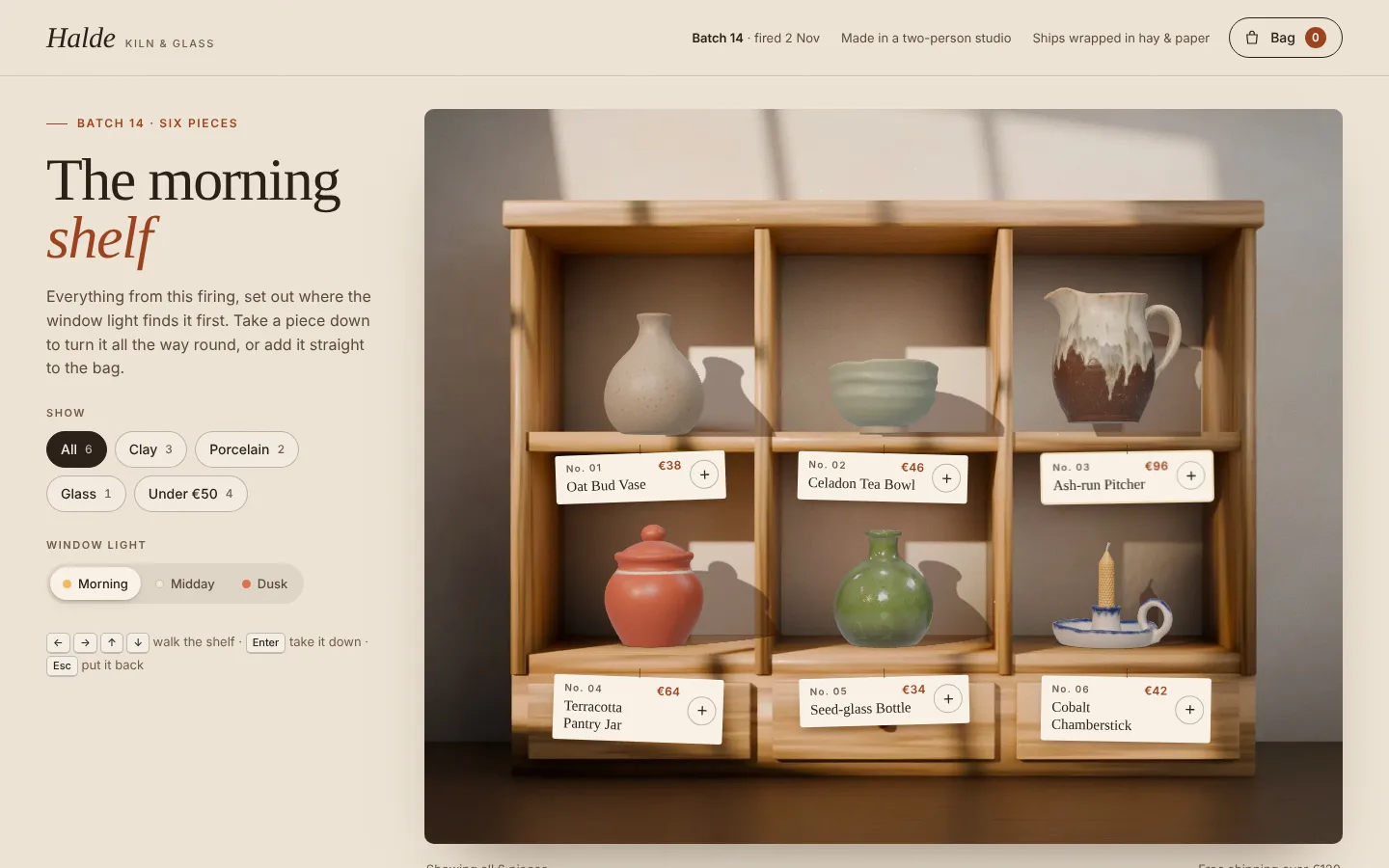
Halde Product grid on a sunlit shelf
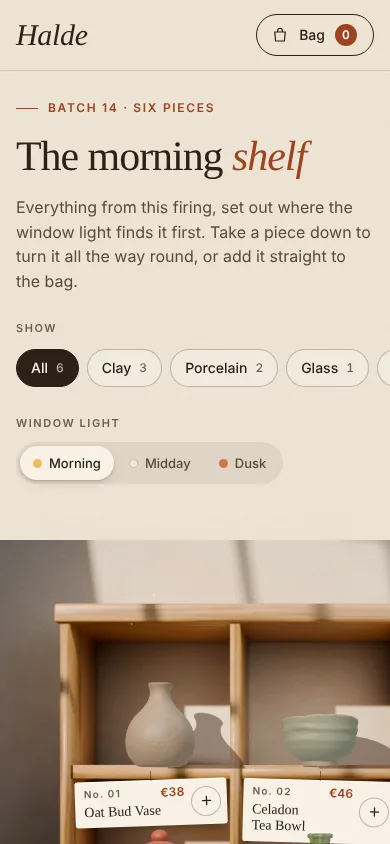
A shop grid staged as an oak shelf in window light. Pieces lift off the shelf onto a turntable you can drag, filters re-flow the shelf and the bag works.
What's in the prompt
- A full written spec: layout, tokens, every animation with its numbers, responsive rules
- The complete working code as the reference implementation
- Accessibility, reduced motion and fallbacks already handled
- A “Make it yours” checklist so your site looks like nobody else’s
- Type
- Section
- Built with
- HTML, CSS, JS · three.js 0.170.0
- Prompt size
- 101 KB
- Tags
- product grid, e-commerce, shopping cart, turntable
- Updated
- 2026-11-26
Use it in three steps
- Copy the prompt with the button above.
- Paste it into your AI (Claude, Claude Code, ChatGPT, Cursor…) and add your edits.
- Launch the single
index.htmlanywhere: Cloudflare Pages, Netlify, GitHub Pages.
About the Halde design
Halde presents a small kiln and glass studio's six pieces on a photoreal oak cabinet rendered in Blender, with real 3D models standing in the bays. The palette stays close to the room: limewashed plaster, dark brown ink, a clay accent for prices and a sage bar for free shipping. Newsreader's italic gives the shop a quiet editorial voice and Hanken Grotesk handles the controls. The signature is taking a piece down: click a jar or pitcher and it lifts out of its bay on an arc to a turntable where you can turn it a full 360°, which suits handmade objects whose backs and handles matter to a buyer.
A visitor lands on the sticky intro with filter chips and a Window light control beside the cabinet. One piece at a time catches the light in a slow cover loop. Switching between Morning, Midday and Dusk cross-fades the rendered room and swings the live shadows. Filters make pieces hop between bays. Opening a piece blurs the shelf, shows its story, specs and stock, and lets you step to the next one. Quick-add buttons on the paper tags fly a cut-out into the bag drawer, which tracks quantities, stock limits and a reserve form.
Good for
- Ceramicists and glassmakers: buyers can turn each piece to see the back and handle
- Small homeware shops: four to six hero products fill the cabinet bays
- Design or furniture brands: the rendered set can become any shelf, rack or plinth
- Limited drops: stock counts and the reserve flow suit small batches
- Product photographers: the camera-locked render shows off a lighting setup
How Halde is built
- Camera locked to a pre-rendered plate. A fixed full-viewport canvas uses a PerspectiveCamera matching the Blender 50mm lens (vertical FOV 26.99°) and calls setViewOffset with the plate's getBoundingClientRect every frame, so live models stand exactly in the rendered oak bays at any scroll or size.
- Shadow catchers on a photo. ShadowMaterial planes (#2a170a, opacity .42) lie on each shelf top and back panel, so a 2048 PCF-soft directional sun casts real model shadows into the rendered image, with a radial blob under each piece for contact shadow.
- Relightable window light. Morning / Midday / Dusk cross-fade three 1440×1152 renders over 1.2s while the three.js sun direction, colour and environment intensity tween to matching values, and each piece is dimmed by the plate's sampled luminance behind its bay.
- Take-it-down flight and turntable. A spring (k 70, damping ratio .92) carries the clicked model along a quadratic Bézier to a growing oak plinth, where drag, swipe or arrow keys turn it a full 360° with .94 friction coasting.
- 3D filter hops with FLIP. Filtering shrinks leaving pieces and hops the rest into the first bays over .65s with sin(π·t)·7cm of lift, while the DOM tags FLIP along the same arc.
Images, video and 3D
Three empty-cabinet renders (plate-morning/noon/dusk.webp) made in Blender Cycles, six GLB models in assets/models/ made with an image-to-3D tool and compressed with gltf-transform (meshopt, WebP textures), and six transparent cut-out WebPs for the 2D fallback. To make your own, render your furniture in Blender under three suns, photograph or AI-generate one clean three-quarter shot per product, convert each to GLB and re-measure the bay constants.
Build it with Claude
In claude.ai, ask for the full index.html but expect the preview to show only the 2D fallback, since it cannot load your local plates and GLBs. Use the preview to check the shop logic: filter chips with correct counts, the bag drawer clamping quantities to stock, free-shipping progress toward €120 and the reserve form errors; then download the file and run it next to your assets.
Claude guide →Build it with Claude Code
Set up index.html with assets/plate-.webp, assets/.webp cut-outs and assets/models/*.glb plus meshopt_decoder.module.js, then serve the folder with npx serve or python3 -m http.server, because GLB loading fails over file://. Ask Claude Code to verify in a headless browser that the six models line up with their bays at 1440 and 390, that shadows move when switching to Dusk, and that WebGL failure leaves the cut-outs working.
Build it with ChatGPT
This prompt has many numeric tables, so ask ChatGPT to produce the file in sections (CSS, DOM, shop script, then the 3D module) or to work in canvas, and tell it to copy the light and camera tables verbatim. The usual follow-up is alignment: check that it uses setViewOffset with the plate rect and the Blender-to-three.js axis swap, not an approximate camera.
ChatGPT guide →If it doesn’t work
- Models float above or beside their bays: the camera must use the exact Blender values (position (0, .47, 2.55), FOV 26.9915) and the Y-up conversion (x, z, −y); any guessed camera breaks the lock.
- GLBs fail to decode: meshopt-compressed files need MeshoptDecoder set on the GLTFLoader, and the page must be served over http, not opened as file://.
- The shop freezes after a stalled animation: race every awaited flight against a timer of duration + 120ms, as the spec says, so the UI never waits forever.
Questions about Halde
Do I need Blender to make my own version of the Halde shelf?
For the full effect, yes: the cabinet plates are Cycles renders and the three.js camera is matched to that render's lens. You can keep the provided plates while swapping only the products and copy, but a new set needs your own render and re-measured bay centres.
What happens on a device without WebGL?
The transparent 2D cut-outs stay on the rendered plate and the detail view uses a CSS turntable with a ±24° tilt. Filters, the bag drawer and the reserve form all keep working.
Make it yours
This prompt rebuilds one exact design. If everyone ships it unchanged, the sites will look alike. Before you paste it, change these lines so the result is yours. Each change is one edit to the prompt; the structure and the interactions stay intact.
- Brand and stock. Swap "Halde", "Batch 14" and the six pieces for your own shop and products: names, prices, stock, stories, the four spec rows and each piece's real height
hm. Keep 4–6 pieces so every bay of the 3 × 2 cabinet can be filled, and 3–5 filter chips. - The set and the take-down. The signature is a live 3D product lifting out of a rendered piece of furniture onto a turntable. Rebuild the set for your world, keeping the camera lock, the shadow catchers and the flight: - a bakery's cooling rack and a cake stand; - a record shop's crate and a spinning platter; - a sneaker wall and a lit plinth; - a florist's bench and a bell jar.
Re-measure the bay centres and shelf heights from your own Blender scene and paste them into the constants.
- The light. Rename the three plates to moments your customer cares about (Shop window / Lamp / Candle, or Summer / Winter). Render each with its own sun direction and colour, and enter the same directions into the three.js light table so the shadows still agree.
- Palette. Replace plaster, ink, clay and paper with your brand colours. Keep
--ink-3and the accent at ≥ 4.5:1 on the ground and on the tag paper. - Type pairing. Swap Newsreader + Hanken Grotesk for another serif or display face with a plain sans for UI. Pick one you have not seen on the last three sites you visited.
- Models and plates. Photograph or generate one clean three-quarter product shot per piece (plain background, soft light), convert each to a GLB with an image-to-3D model, and optimise it with gltf-transform (meshopt + WebP, 1024 px textures). Re-render the plates from your own Blender scene.
- Copy. Rewrite the heading, lead, stories, stock lines and the reserve flow in your own voice. Say exactly what happens after checkout ("we hold reserved pieces for 48 hours"), not "complete your purchase".
Tell your AI: "Build exactly as specified, but with these changes: …", then list your edits.