Site · E-commerce
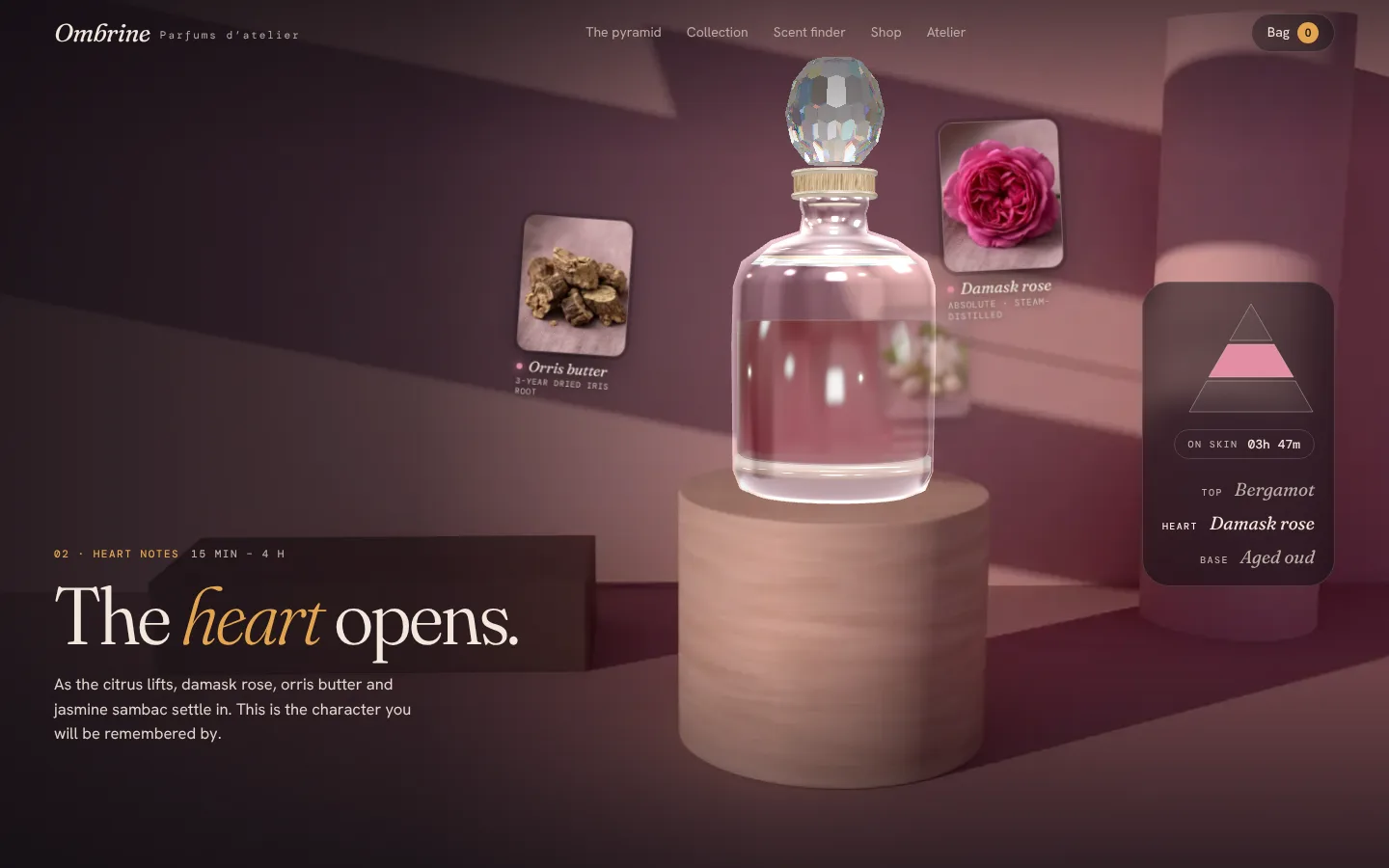
Ombrine Perfume atelier with a live glass flacon
A perfume house where a physically lit glass bottle changes with the scent pyramid as you scroll, with a scent finder and a working bag.
What's in the prompt
- A full written spec: layout, tokens, every animation with its numbers, responsive rules
- The complete working code as the reference implementation
- Accessibility, reduced motion and fallbacks already handled
- A “Make it yours” checklist so your site looks like nobody else’s
- Type
- Site
- Built with
- HTML, CSS, JS · three.js 0.170.0
- Prompt size
- 99 KB
- Tags
- three.js glass, luxury, e-commerce, scroll
- Updated
- 2026-11-26
Use it in three steps
- Copy the prompt with the button above.
- Paste it into your AI (Claude, Claude Code, ChatGPT, Cursor…) and add your edits.
- Launch the single
index.htmlanywhere: Cloudflare Pages, Netlify, GitHub Pages.
About the Ombrine design
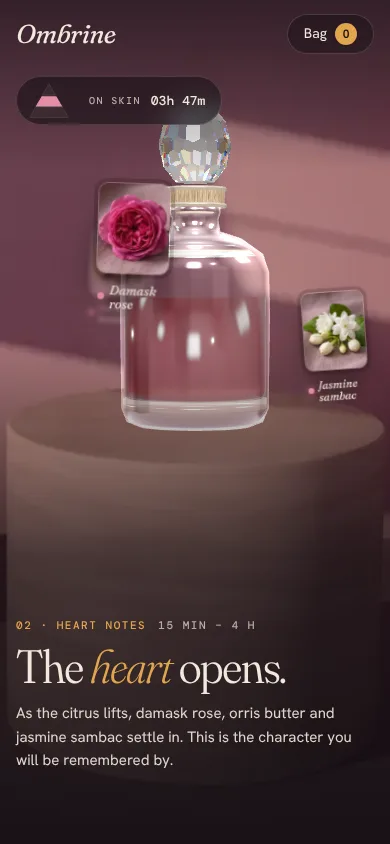
Ombrine is a landing page for a fictional niche perfumer's atelier, set on a smoky night-plum ground with vellum text and one saffron accent. Fraunces in a soft, light weight, with one italic saffron word in every heading, gives it a label-like voice, while Hanken Grotesk and DM Mono handle the shop and the small capitals. A live three.js glass flacon stands on the travertine drum of a Blender Cycles render, and its faceted crystal stopper is ray-traced in its own fragment shader. The signature turns the scroll into the life of a scent on skin, so the effect explains how perfume changes over a day, which is what a buyer most needs to understand.
After a preloader with a falling saffron drop and real progress, the visitor scrolls a 520vh pinned stage. The rendered room relights from morning sun to dusk rose to candlelight, the liquid moves from champagne through citrus, rose and amber while its level drops, an On skin clock runs from 00h to 24h, and nine ingredient cards orbit the bottle, three per tier. Below are a filterable collection of four scents, a three-question scent finder, a pinned shop strip of live 3D flacons that resize for 10, 50 or 100 ml, an atelier story with counted stats and a bag drawer.
Good for
- Perfumers and fragrance houses: top, heart and base notes map onto the three-tier timeline
- Tea merchants: the prompt suggests a tea glass steeping from first flush to dark
- Wine and spirits brands: a decanter can move through three tasting notes
- Candle makers: a candle can burn down through its layers instead of draining
- Skincare lines: a dropper bottle can run through morning, day and night
How Ombrine is built
- Ray-traced crystal stopper. A ShaderMaterial on a proxy box traces 82 planes tangent to an ellipsoid; each of R, G and B refracts in with its own IOR (1.58, 1.63, 1.69), bounces up to 5 times (3 on phones) with total internal reflection, and exits into a 192 px cube map of the scene updated every second frame.
- Shared plate mapping. layoutPlate() cover-fits the 1600×900 render and pans it so the drum top (u .586, v .564) lands at a set screen point per breakpoint; the same numbers place the GLSL backdrop, the DOM posters, the SVG fallback and the orbit centre.
- Scroll-scrubbed scent timeline. Progress through the section drives intro = 1 − smoothstep(.05, .13, p), a tier value k from 0 to 2 that mixes the three plates, a liquid level falling from .92 by up to .4, and an On skin clock of 1440·smoothstep(.1, .98, p)^2.2 minutes.
- Depth-sorted ingredient orbit. Nine cards ride a tilted ellipse at angle p·2.4π + i·2π/3 + tier·.9, and each card's scale, blur (up to about 14 px) and opacity come from its depth and from how close k is to its own tier.
- One offscreen renderer for the shop. A single WebGLRenderer at DPR ≤ 1.5 draws each visible shop card's flacon with its own plate, liquid, cap and size spring (scale .70 / .86 / 1.00, spring 160/16) and copies the result into that card's 2D canvas.
Images, video and 3D
Four 1600×900 Cycles plates of one set (a travertine drum, a dark slab, a plaster column and a window gobo) lit as morning sun, dusk rose, candlelight and overcast green, four 880×1100 Cycles product renders of the flacon, nine 360² ingredient photos, an atelier photo and a discovery-set photo, about 0.6 MB in all. Rebuild the set in Blender with one camera, change only the light per tier and measure the new plinth-top u, v and width; shoot or generate the ingredient photos in one light and crop.
Build it with Claude
Ask Claude for the full index.html. The preview will not have your plates or renders, so judge the logic rather than the look: the scent finder's Next button staying disabled until each step is answered, the match percentage (68 + best/9 × 31), the size pills updating prices such as Lueur €42 / €145 / €210, and the bag's €150 free-shipping meter.
Claude guide →Build it with Claude Code
Create index.html with the plates, renders, ingredient cards and photos in assets/ and serve the folder with python3 -m http.server, since the textures need http. Ask Claude Code to scroll the pinned stage headlessly and confirm the three jump buttons land at p .26, .54 and .84, that blocking the CDN adds .no-gl and shows the SVG flacon, and that there is no horizontal scroll at 390, 768 and 1440.
Build it with ChatGPT
Ask ChatGPT for the classic UI script, the three.js module and the stopper shader as separate parts, or in canvas, since the stopper trace alone is long. Expect a follow-up on alignment: check that one layoutPlate() function feeds the shader backdrop, the posters and the orbit, so the bottle stays on the drum at every breakpoint.
ChatGPT guide →If it doesn’t work
- The liquid disappears inside the bottle: draw the outer shell with AdditiveBlending and depthWrite off, so only its highlights add and the nested transmission does not hide the liquid.
- The bottle floats off the drum on tablets and phones: use the per-breakpoint fx, fy, zoom and width factors from the prompt's table, and measure the section box on resize rather than every frame.
- The page stalls on a slow GPU: force the preloader to 100% after 5 s, run render loops only while their section is on screen, and drop the stopper to 3 bounces on phones.
Questions about Ombrine
Is the Ombrine bottle a 3D model file?
No. The flacon is built in three.js from lathe profiles and MeshPhysical materials, and the stopper is a ray-traced shader on a box. The Cycles renders are used for the room plates, the collection cards and the no-WebGL fallback.
What happens without WebGL2?
The page adds .no-gl and shows an SVG flacon placed with the same plate mapping, whose liquid follows the scroll. The plates cross-fade per tier, and the orbit, clock, finder, shop strip and bag keep working with product renders in place of live canvases.
Make it yours
This prompt rebuilds one exact design. If everyone ships it unchanged, the sites will look alike. Before you paste it, change these lines so the result is yours. Each change is one edit to the prompt; the structure and the interactions stay intact.
- Brand and offer. Swap "Ombrine" and its four scents for your own house and products, with names, notes and prices. Keep four products plus one set, so the 4-up grid and the five-card strip still balance.
- The vessel. The flacon that drains and changes colour on a rendered plinth is the signature. Re-theme it with one vessel from your world, keeping the three-tier
ktimeline, the colour stops, the falling level and the ray-traced stopper (re-cut its facet rings): - a tea glass steeping from first flush to dark, with a faceted glass lid; - a wine decanter through three tasting notes, with a crystal stopper; - a candle burning down through its layers, with a cut-glass cloche; - a skincare dropper through morning / day / night, with a gem-cut bulb.
The lathe profile is one array of points.
- The set. Re-render the plates as your own space, built in Blender or hosted 3D: a marble plinth in a gallery, a wooden stool in a tea house, a bar top. Keep one camera and change only the light per tier, then measure the new plinth-top
u / v / wand put them inPLATE. - The three tiers and nine cards. Replace top / heart / base and the nine ingredients with the three stages and nine ingredients your product really has, photographed or rendered in one consistent light and crop (square, centred, no text).
- Palette. Replace
--ink,--night,--vellumand the saffron accent with your brand colours, and set the four liquid stops to your product colours. Keep--muteat ≥ 4.5:1 on the ground. - Type pairing. Swap Fraunces + Hanken Grotesk + DM Mono for another expressive serif with italics (keep one italic accent word per heading), a plain sans and a mono.
- The finder. Rewrite the three questions as the questions your customers ask before buying, and rebuild the 3×4×4 points table so every product can win.
- Copy. Rewrite every heading in your own voice, specific to the product ("still on your scarf the next morning", not "an unforgettable experience").
Tell your AI: "Build exactly as specified, but with these changes: …", then list your edits.