✦ Members Site · Portfolio
Sollo Industrial designer portfolio with a 3D exploded view
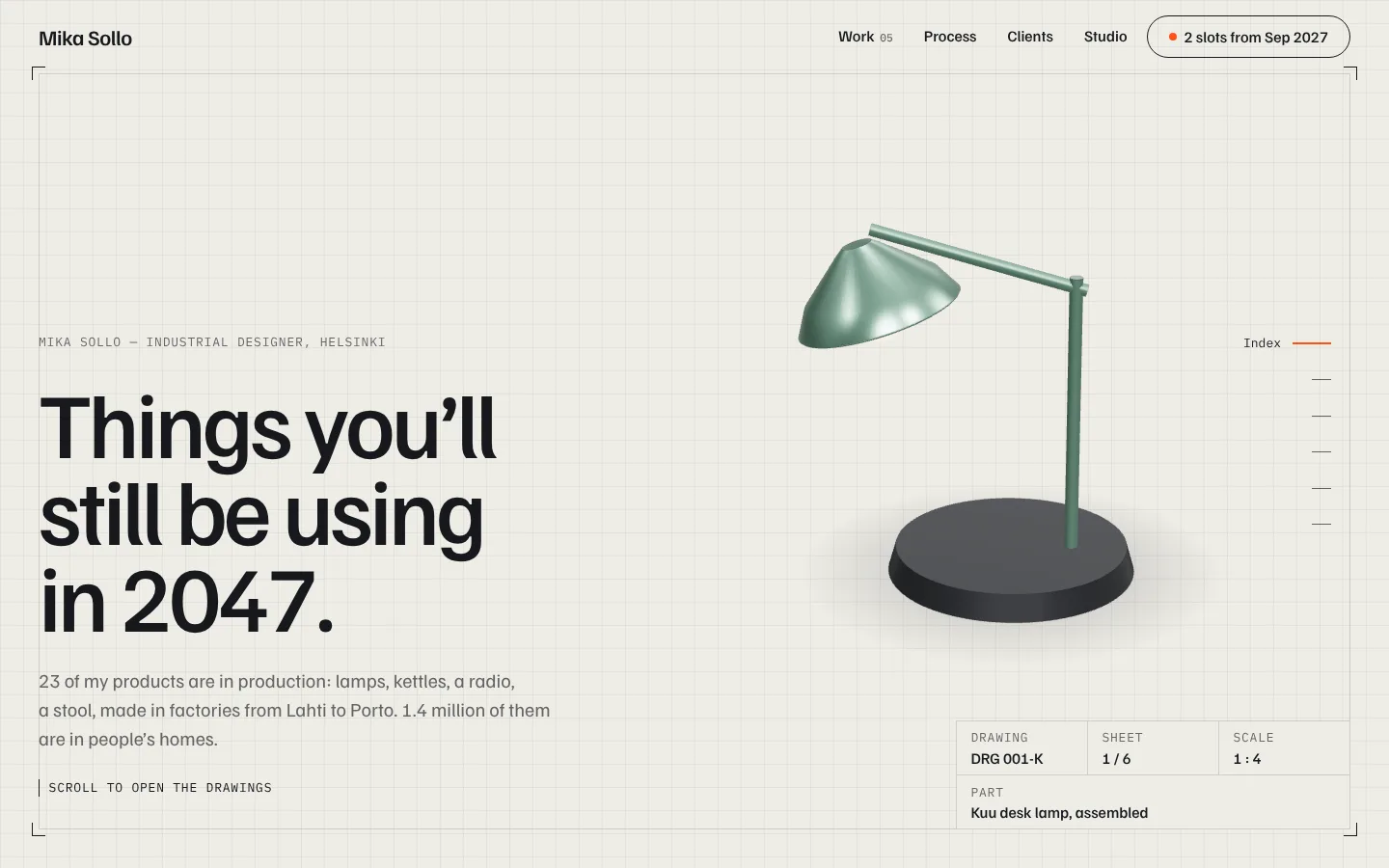
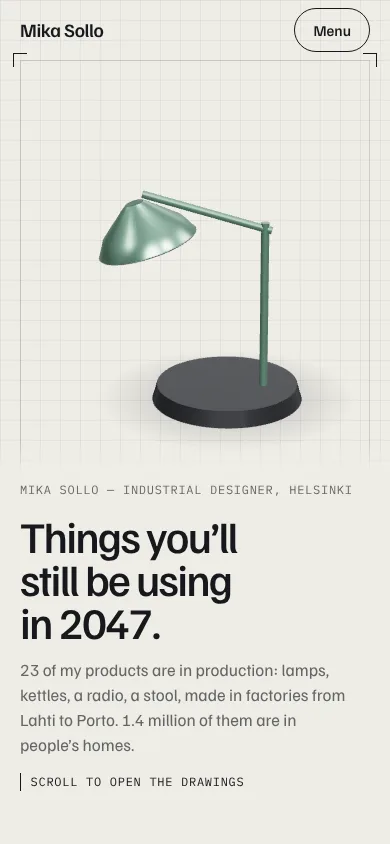
A product designer's portfolio drawn as a technical sheet. Each product plots itself in ink, fills into a real 3D object and explodes into labelled parts as you scroll.
Unlock free with your emailPrompt 217 KB · code .zip 1.3 MB
Members
Unlock the prompt, demo and code
Free with your email. We send a confirm link; it unlocks every Members template on this browser.
Check your inbox
We sent the unlock link to . Open it in this browser and every Members template unlocks.
Nothing after a few minutes? Look in spam or promotions. Wrong address?
Unlocked on this browser
What's in the prompt
- A full written spec: layout, tokens, every animation with its numbers, responsive rules
- The complete working code as the reference implementation, also as a ready-to-run .zip with every image, video and 3D model
- Accessibility, reduced motion and fallbacks already handled
- A “Make it yours” checklist so your site looks like nobody else’s
- Type
- Site
- Built with
- HTML, CSS, JS · three.js 0.170.0, Lenis 1.3.26
- Prompt size
- 217 KB
- Tags
- portfolio, three.js, exploded view, product design, scroll storytelling
- Updated
- 2026-11-28
Use it in three steps
- Unlock it free with your email, then copy the prompt.
- Paste it into your AI (Claude, Claude Code, ChatGPT, Cursor…) and add your edits.
- Launch the single
index.htmlanywhere: Cloudflare Pages, Netlify, GitHub Pages.
About the Sollo design
Sollo is the portfolio of Mika Sollo, a fictional industrial designer in Helsinki with 23 products in production and 1.4 million made. The top of the page is a technical drawing sheet: a paper ground with a drafting grid, a hairline frame with registration marks, an engineering title block that updates per sheet (drawing number, sheet n/6, scale, part) and a rail of six ticks. The palette is ink on paper with one construction-orange accent used only for construction marks; Familjen Grotesk sets the words and IBM Plex Mono every label. A pen plots an MS monogram as the page really loads, and its border lands exactly on the sheet's frame.
The signature is a 700lvh pinned stage. Each of five products (a desk lamp, a kettle, a radio, a stool and a pepper mill) plots its edges as ink lines, fills into a solid object and, as you scroll through its sheet, explodes along its assembly axes while the camera pulls back to keep it framed and orange leaders run to part labels with materials and numbers. Below come five photographs of the products in use that each open their drawing, four process counters with self-drawing figures, a clients ledger, a studio section with a portrait and the workshop, and a dark contact footer with a live Helsinki clock.
Good for
- Product, furniture and lighting designers who want the work shown as objects, not thumbnails
- Hardware and consumer-electronics brands explaining what is inside a product, part by part
- Architects, engineers and makers whose work already lives in drawings and title blocks
- Any portfolio with 3–6 hero pieces that each deserve a full screen and a spec table
How Sollo is built
- Objects plotted, then filled. Every mesh gets an EdgesGeometry twin drawn with LineDashedMaterial. On arrival each line set's dashSize grows from 0 to its total line distance over 950 ms (ease-out-cubic, parts 5% apart); the solid fades in from 70% of the plot over 650 ms and the lines dim to 16%.
- Explode set by the scroll, framed by the camera. Each part moves home + dir × smoothstep(.28, .72) of its sheet. Bounding spheres of the assembled and the fully exploded object are measured once; the object is recentred between their centres and the camera distance is fitted to the interpolated radius inside a focus box, so nothing ever leaves the sheet.
- Labels that never collide. Each label anchors to its part's own bounding-box centre, sits on the side of the object its part is on, and each side is sorted top to bottom and pushed apart with a 6 px gap inside the focus box. Label sizes are measured only when the text changes, so no layout is read per frame.
- Building the scene without blocking. The environment, then one object per task, then one compileAsync per part, each followed by scheduler.yield. Nothing renders while the preloader covers the stage, and the preloader's progress is weighted by fonts, the scene build and load.
- Still pictures as the fallback. If WebGL is missing, the renderer fails, three.js never arrives or the context is lost three times, html.no-gl shows a transparent render of the current product in the same focus box, and the red banner names what failed.
Images, video and 3D
The download includes seven photographs made with an AI image generator as one set (overcast north-window light, plaster and oak): the five products in use at 480/800/1200 px, a studio portrait and the workshop bench, about 960 KB as WebP. Five transparent renders of the 3D objects are the no-WebGL fallback. The objects themselves need no files. Members template: unlock free with your email.
Build it with Claude
Ask Claude for the full index.html in one pass, with the assets folder beside it. Scroll through all five sheets and check that each object plots, fills and explodes with labels that touch nothing, and that the title block and rail follow along. Then open a photo in the In use grid and check it glides back to its drawing.
Claude guide →Build it with Claude Code
Serve the folder with python3 -m http.server and have Claude Code screenshot each sheet at 62% of its scroll at 1440, 1024, 768 and 390, then run it with reduced motion, with three.js blocked (stills and a red banner should appear) and with a crawler user agent, checking for console errors and sideways scroll.
Build it with ChatGPT
Ask for the page in parts: the shell, tokens and frame scaling; the preloader; the stage markup with the title block and rail; the three.js module (object kit, framing, labels, hand-over); then the sections below. Check that the camera distance uses the exploded bounding sphere, or the exploded objects leave the sheet.
ChatGPT guide →If it doesn’t work
- A constant idle spin turned some objects edge-on at the moment you read them; a ±15° sway around the front keeps every product readable.
- Anchoring labels to each part group's origin put leaders in empty space; use the centre of the part's own bounding box.
- Compiling every shader in one call blocked the main thread for over a second on a slow phone; compile part by part and yield between them.
- Hiding inactive panels with visibility:hidden removed the h1 and the other projects from screen readers; use opacity, since the panels hold nothing focusable.
Questions about Sollo
Do I need 3D models?
No. The five products are built in code from lathe profiles, cylinders, tori and a rounded box, so you swap one make function per product. A lathe profile covers most turned or spun objects.
What happens without WebGL?
A still picture of the current product appears in the same place, the labels stay hidden, the page works, and a red banner says what failed. Reduced motion keeps the 3D but stops the sway and the plotting.
Can I use photographs of my real products?
Yes. Replace the five In use photos and keep the 4:5 crops. If you generate them, describe each product's exact shape, colours and materials so the photos match the 3D objects.
Make it yours
This prompt rebuilds one exact design. If everyone ships it unchanged, the sites will look alike. Before you paste it, change these lines so the result is yours. Each change is one edit to the prompt; the structure and the interactions stay intact.
- The designer and the studio. Swap Mika Sollo, Helsinki, Kalasatama and the facts for your own: a furniture maker in Porto, a lighting studio in Melbourne, a consumer-electronics team in Seoul. Keep the four facts that are numbers (founded, products, units, projects a year); they carry the voice.
- The five objects. Replace each
make*()with your own products, built from the same primitives. A lathe profile covers bottles, vases, lamps and grinders.RoundedBoxGeometrycovers speakers, routers and power banks. Cylinders and tori cover chairs, handles and wheels. Give each part a real assembly direction and a label with a material and a number ("Ø8", "0.8 mm", "6 W"). Keep 3–6 parts per object, or the labels crowd. Re-render the five stills afterwards. - The drawing sheet. Keep the title block but rename its cells for your trade: an architect's "Plan · Level · Scale", a type foundry's "Weight · Glyphs · Version", a bike builder's "Frame · Size · Tubing". Change the grid pitch or swap it for a dot grid.
- The accent and the ink. Replace construction orange with your own single accent: blueprint cyan on a navy sheet, red pencil on cream, signal green on graphite. Keep the rule that the accent marks construction only (leaders, axes, progress), never text, and keep muted text ≥ 4.5:1 on your ground.
- Type pairing. Swap Familjen Grotesk for another grotesk with character (Bricolage Grotesque, Schibsted Grotesk, Hanken Grotesk). Keep a monospace for every label, because the drawing voice depends on it (JetBrains Mono, Space Mono, DM Mono).
- The process counts. Replace 214 / 31 / 9 / 1 with your own real pipeline (interviews → concepts → prototypes → launch; drafts → fittings → samples → run) and redraw the four line drawings in the same single-stroke style.
- Photographs. Replace the In use pictures and the studio portrait with your own. If you generate them, put each product's exact shape, colours and materials in the prompt, so the photographs match the 3D objects, and reuse one art-direction block for all of them. Keep the 4:5 crops and write captions that say when and where ("06:55 · a kitchen in Kallio").
- Copy. Rewrite the hero claim ("Things you'll still be using in 2047.") in your own voice, with a year, a number or a promise in it. Make every project text say one physical fact about the object, and tell clients how many slots you have and when.
Tell your AI: "Build exactly as specified, but with these changes: …", then list your edits.
---
Commissions
Want Sollo for your brand?
We build it for you: your story, your copy, motion made for your brand, live on your domain. Two projects a month, so each one gets the same care as this template.
- A cinematic site made for your brand, not a reskin
- Original motion and imagery made for your story
- Fast on phones, accessible, yours to keep
Thank you. We have it.
We read every inquiry ourselves and reply from hello@copytheprompt.design within two working days. Add that address to your contacts so the reply doesn’t land in spam.