✦ Members Site · Landing page
Cinder & Salt Wood-fire grill restaurant site on a scroll-cooked film
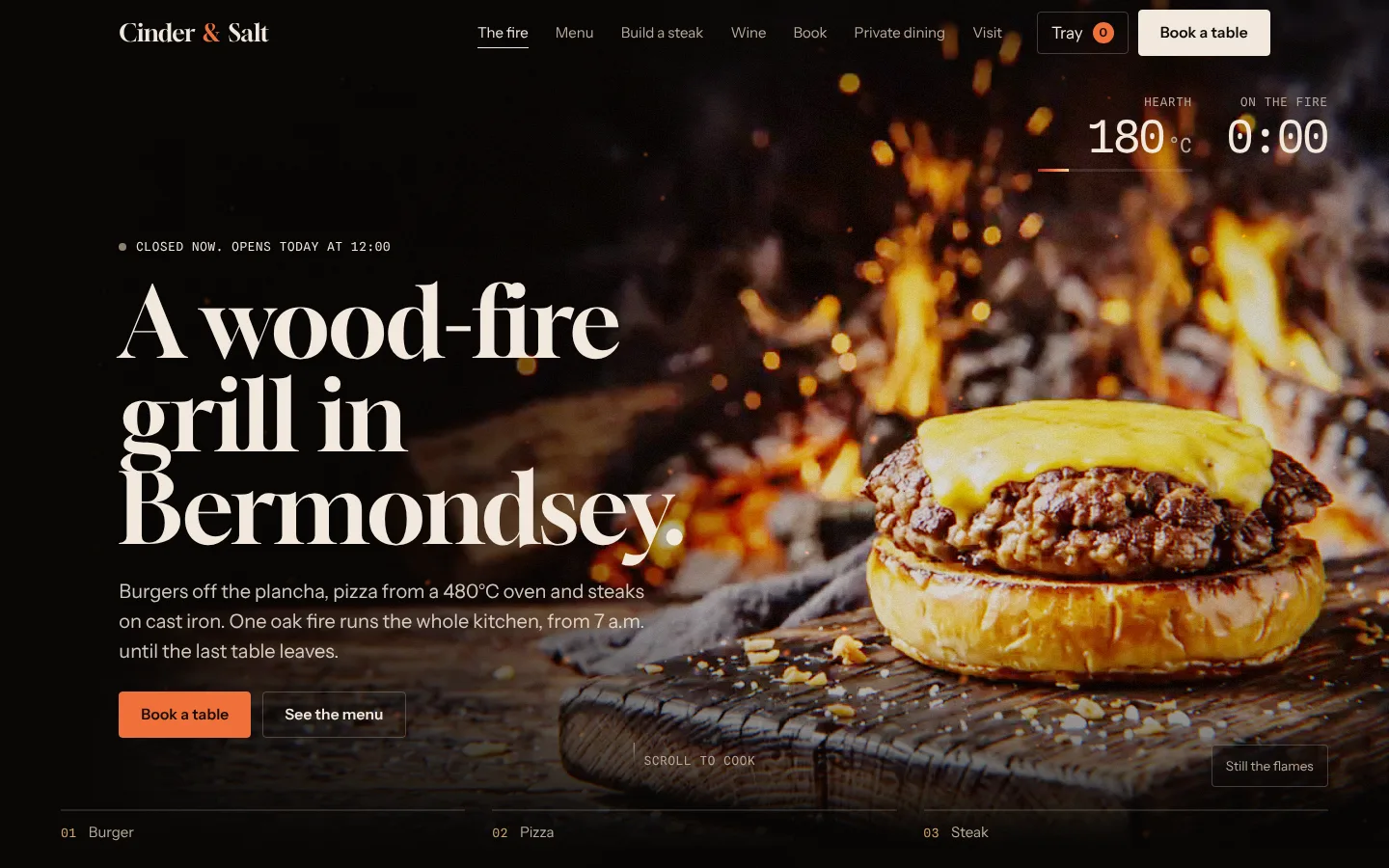
A grill house where scroll cooks three signature dishes in a fire film, with a working menu, steak builder, order tray and table booking.
Unlock free with your emailPrompt 121 KB · code .zip 9.7 MB
Members
Unlock the prompt, demo and code
Free with your email. We send a confirm link; it unlocks every Members template on this browser.
Check your inbox
We sent the unlock link to . Open it in this browser and every Members template unlocks.
Nothing after a few minutes? Look in spam or promotions. Wrong address?
Unlocked on this browser
What's in the prompt
- A full written spec: layout, tokens, every animation with its numbers, responsive rules
- The complete working code as the reference implementation, also as a ready-to-run .zip with every image, video and 3D model
- Accessibility, reduced motion and fallbacks already handled
- A “Make it yours” checklist so your site looks like nobody else’s
- Type
- Site
- Built with
- HTML, CSS, JS · no libraries
- Prompt size
- 121 KB
- Tags
- restaurant, scroll video, webgl, booking, ai video
- Updated
- 2026-11-28
Use it in three steps
- Unlock it free with your email, then copy the prompt.
- Paste it into your AI (Claude, Claude Code, ChatGPT, Cursor…) and add your edits.
- Launch the single
index.htmlanywhere: Cloudflare Pages, Netlify, GitHub Pages.
About the Cinder & Salt design
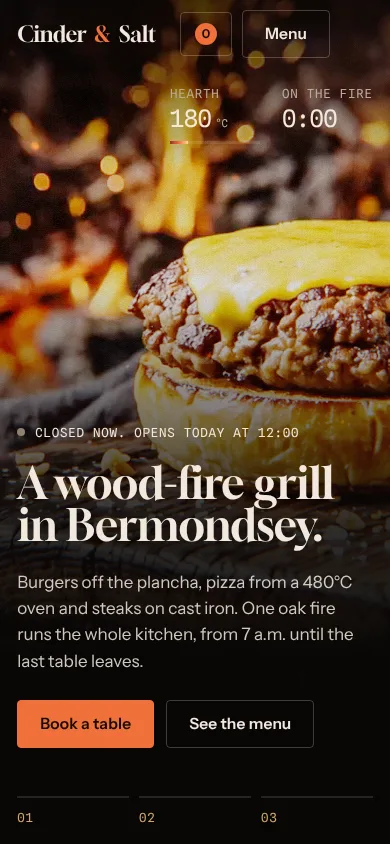
Cinder & Salt is a full website for a fictional wood-fire grill house in Bermondsey, London. The palette is soot black and bone white with one ember-orange accent and a brass for labels. Gloock sets the headings and prices, Instrument Sans the body and Spline Sans Mono the HUD, times and labels. The signature is a 560vh section (500vh on phones) with a sticky film in three acts, one per signature dish: a burger stack assembles in front of an oak fire, a raw pizza puffs and blisters in a wood oven, and a bone-in ribeye sears in cast iron. Scrolling down cooks each dish, scrolling up uncooks it, and the film rests for a moment on each finished plate.
The film is drawn through a WebGL post pass with heat haze above the dish, rising embers, a filmic grade, vignette, grain, a slight colour fringe and a heat ripple that follows the cursor. A HUD reads the zone, its temperature and the cook time, chapter bars jump between acts, and each act can add its dish to the tray. Below come the hearth story with a burn log, a menu with six tabs and dietary filters, a steak builder whose sliced-ribeye photo changes with doneness, a wine pairing that can read the tray, table booking with slots and a calendar file, a private dining calculator and enquiry, hours with a live open or closed status, an SVG map, an FAQ and a slide-in order tray. The page is about 17.6 screens at 1440 and has no dead buttons.
Good for
- Grill houses, steak restaurants and pizzerias: three cooking moments carry the first screens and each links to an order
- Restaurants that take collection orders: the tray offers the next ten open 15-minute slots and returns an order reference
- Places with a set booking pattern: slots follow your opening hours, closed days are disabled and a confirmation downloads an .ics file
- Venues with a private room: the calculator works out sets, guests, wine flight, 12.5% service and a weekend minimum spend
- Any kitchen with one visible process (a tandoor, a smokehouse, a bakery): swap the three clips and retune the HUD readings
How Cinder & Salt is built
- Film keyed to scroll with rests. Scroll progress maps piecewise-linearly through ten keyframes (from [0,0] and [.07,0] to [.95,17.36] and [1,17.42]) to film seconds, so each finished dish holds for a moment and the 0.5 s crossfades fall between the rests. Smoothing is frame-rate independent:
pS += (p − pS)·(1 − 0.84^(dt·60)). - One seek in flight, film in memory. The MP4 is fetched whole with a streamed reader, so the preloader shows real bytes, then played from a Blob URL. Only one seek runs at a time;
seekedstarts the newest pending target, and seeks under 1/50 s are skipped. The video texture is re-uploaded only when a seek lands. - Raw WebGL post pass. Heat haze from two value-noise samples weighted toward the top of the frame, a cursor ripple
sin(d·70 − t·7)·0.0016·e^(−9d), an ACES-fitted grade with warm shadows, and up to three ember grid layers (two on phones or devices with four cores or fewer). DPR is capped at 1.25 on phones and 1.5 on desktop, and a "Still the flames" toggle freezes it. - HUD driven by the act. Each zone's temperature eases from start to target (Plancha 180→262 °C, Oven 300→482 °C, Iron 220→302 °C) over the first 85% of its act, while the timer counts to 4:00, 1:30 or 8:00 and the gauge scales from .3 to 1.
- Deterministic booking slots. Slots every 15 minutes up to 90 minutes before close come from the real opening hours in London time via
Intl. Availability is an FNV hash of date, time, seat and party compared with a capacity, so the same request always gives the same answer; the hearth counter takes no more than 4 guests.
Images, video and 3D
All imagery and film were made with AI image and video generation for this template (no stock footage), so the zip includes them. The film is three 6 s image-to-video clips, each generated from a raw start still and a finished end still with the same plate and camera, joined with 0.5 s fades: fire.mp4 is 1280×720, 15 fps, all-intra, 17.4 s and 4.8 MB, and fire-portrait.mp4 is a 540×960 crop at 3.7 MB, with WebP posters. The stills include the three finished dishes, six photos of one sliced ribeye from blue to well done in the same framing, the hearth, small plates, wine, the dining room and the private room, with 600 or 800 px variants. Members template: unlock free with your email.
Build it with Claude
Ask Claude for the full index.html in one pass. The preview has no film file, so the act posters stand in for the film and every flow below can still be tested. Check that the menu tabs move with the arrow keys, that Vegetarian plus No gluten shows the empty state, that the builder reads Blue 46°C at the first step, and that booking rejects a missing name or time and that the hearth counter is not offered for more than four guests.
Claude guide →Build it with Claude Code
Put the zip's assets/ folder next to index.html and serve it with python3 -m http.server, because the film loads through fetch and will not stream from file://. If you shoot your own three dishes, re-encode the joined clip with /tools/scroll-video-encoder/ (every frame a keyframe) and ask Claude Code to re-time the FILM keyframes to your clip lengths. Then have it scroll headlessly and confirm currentTime moves through all three acts, that a stubbed getContext falls back to the plain video, and that reduced motion shows four stills with working buttons.
Build it with ChatGPT
Ask ChatGPT for the page in parts, or in canvas: the HTML and CSS, the film scrub and preloader, the WebGL pass, then the menu and builder, booking and private dining, and the tray. A common follow-up is the shader's cover-fit: on desktop it samples with a 0.15 UV shift so the dish sits right of the copy, and on phones it lifts the portrait cut with sy=.2, so check both before judging the framing.
If it doesn’t work
- Scrubbing jumps between frames: the clip must be all-intra, so re-encode with /tools/scroll-video-encoder/ or
-g 1 -keyint_min 1in ffmpeg. - The film never appears when the page is opened from a folder: serve it over http so the streamed fetch can run.
- After swapping clips the finished dishes no longer rest on screen: retune the
FILMkeyframe table to your clip lengths and fade positions. - Booking slots look wrong for your timezone: the hours and the 30-minute cut-off use London time via
Intl, so change the zone along withHOURS.
Questions about Cinder & Salt
Is the fire film included in the Cinder & Salt zip?
Yes. The film and every photo were made with AI image and video generation for this template, so the zip includes fire.mp4 (1280×720, 4.8 MB), fire-portrait.mp4 (540×960, 3.7 MB), the posters and all stills. It is a Members template: unlock the prompt, live demo and zip free with your email.
Do orders and bookings actually get sent anywhere?
No. The tray, booking and private dining enquiry validate input and return a reference, and the booking offers a real .ics download, but nothing is posted to a server. Connect them to your own ordering or reservations system before launch. The tray is kept in localStorage under cs-tray.
How do I make my own three dish clips?
For each dish, generate a 16:9 finished still, then a raw start still using it as the reference so plate, camera and fire match. Run image-to-video with both frames for about 6 s with a locked-off camera, join the clips with 0.5 s fades, and encode all-intra at 15 fps with /tools/scroll-video-encoder/.
What happens on phones, with reduced motion or without WebGL?
Phones get the 540×960 portrait cut with the dish lifted above the copy and fewer ember layers. With reduced motion there is no film or loader: the section becomes four full-height stills with the act copy and buttons. Without WebGL, the plain video is shown and scrubbed the same way with a CSS grade.
How heavy is the page?
About 6.5 MB on desktop and 5.5 MB on phones, nearly all of it the film. The rendering loop runs only while the fire section is on screen and the tab is visible.
Make it yours
Keep the structure, the scroll-scrubbed film, the post pass, the tray and every working flow. Change these so your site is not a copy:
- Brand and offer. Rename the place and pick your own three signature dishes. The film can show any three cooking moments that change visibly in 5–6 seconds: a whole fish blistering on a grill, a flatbread puffing in a tandoor, ramen broth pouring over noodles, a tarte tatin flipped out of a pan. Keep each act title to 2–4 words, so it fits on two lines at 92px, and the description under 45 words.
- Re-shoot the film. For each dish, generate a 16:9 start frame (the raw state) and an end frame (the finished dish) with the same camera, plate and background. Use the end frame as the reference image for the start frame. Then run image-to-video with both frames, a locked-off camera and "one continuous shot, no cuts", 6 s. Join the clips with 0.5 s
xfade, encode all-intra (-g 1, 15 fps, crf 31–33) and re-time theFILMkeyframes to your clip lengths. - Re-theme the heat. Change what the HUD reads to fit your kitchen: a smokehouse reads pit temperature and hours, a sushi counter reads rice temperature and seconds since cut, a bakery reads oven and proof. Change the ember colour in the shader (
vec3(1,.42,.1)) to match: blue-white for a gas wok, pale gold for a bakery. Drop the haze for anything served cold. - Palette. Swap
--soot,--coal,--bone,--emberand--brass, keeping body text at 4.5:1 or better on the ground (bone on soot is about 15:1, ash about 8:1). One warm accent is enough. A light version works too: invert the grounds and darken the shade gradients to a cream wash. - Type. Replace Gloock with another high-contrast display serif (DM Serif Display, Young Serif, Bodoni Moda) or a condensed grotesk (Anton, Big Shoulders). Keep one mono for the HUD and times, and one plain sans for UI.
- The builder. Point it at your own customisable dish: a pizza with doneness swapped for "char level", a curry with a heat scale, a cocktail with sweetness. Re-generate the six-image doneness strip as six states of that dish in one fixed framing.
- Copy voice. Write like the head chef talks: times, temperatures, woods, suppliers, numbers. No adjectives the photo already shows. Keep the address to street and district, and the email on
.exampleuntil it is real. - Hours, capacity and money. Replace
HOURS, the slot capacity rule, the menu prices, the wine matrix, the private dining sets and the £1,200 minimum with your own. Keep the "Fictional brand, demo content" line until everything on the page is true.
"Build exactly as specified, but with these changes: …"
Commissions
Want Cinder & Salt for your brand?
We build it for you: your story, your copy, motion made for your brand, live on your domain. Two projects a month, so each one gets the same care as this template.
- A cinematic site made for your brand, not a reskin
- Original motion and imagery made for your story
- Fast on phones, accessible, yours to keep
Thank you. We have it.
We read every inquiry ourselves and reply from hello@copytheprompt.design within two working days. Add that address to your contacts so the reply doesn’t land in spam.