Site · Landing page
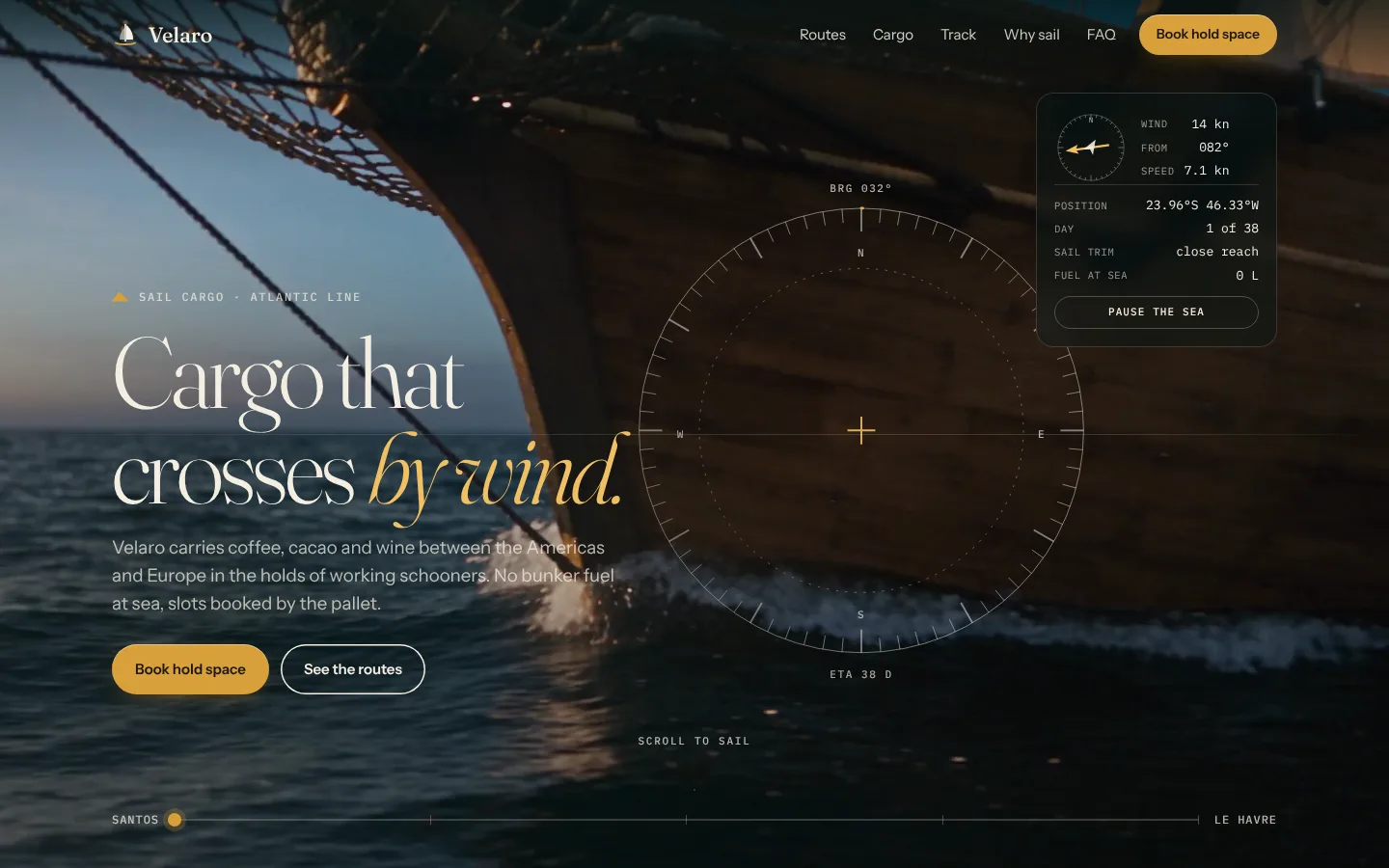
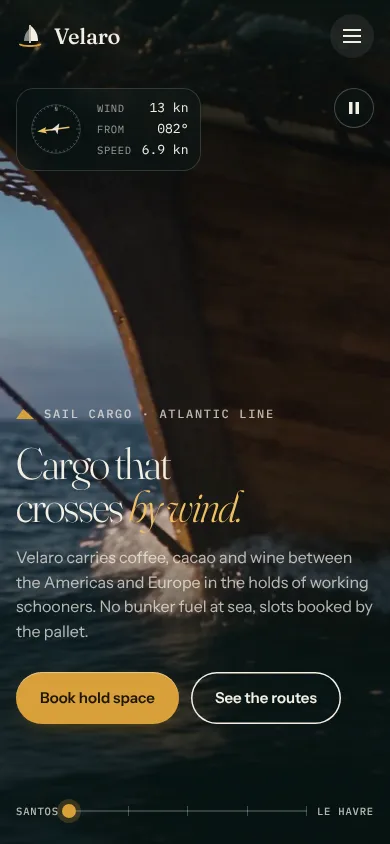
Velaro Shipping line with a scroll-sailed 3D schooner
A schooner sails a live ocean from dusk to night as you scroll. Route map, pallet booking with a hold plan and a voyage tracker.
What's in the prompt
- A full written spec: layout, tokens, every animation with its numbers, responsive rules
- The complete working code as the reference implementation
- Accessibility, reduced motion and fallbacks already handled
- A “Make it yours” checklist so your site looks like nobody else’s
- Type
- Site
- Built with
- HTML, CSS, JS · three.js 0.170.0
- Prompt size
- 145 KB
- Tags
- logistics, three.js ocean, booking, landing page
- Updated
- 2026-11-26
Use it in three steps
- Copy the prompt with the button above.
- Paste it into your AI (Claude, Claude Code, ChatGPT, Cursor…) and add your edits.
- Launch the single
index.htmlanywhere: Cloudflare Pages, Netlify, GitHub Pages.
About the Velaro design
Velaro is a landing page for a fictional sail-cargo line that carries coffee, cacao and wine across the Atlantic on working schooners, booked by the pallet. The art direction is calm and instrument-like: warm sailcloth sand, deep kelp green and a single brass accent. Fraunces Light sets large, quiet headlines with italic words in kelp or brass, Instrument Sans the body, and IBM Plex Mono the readouts and labels. The signature is a hero that plays one 38-day crossing in two acts, which suits a service whose whole pitch is slower, wind-powered transport.
After a Hoisting sail preloader, scrolling first scrubs a drone shot rising past the bow at dusk under a bearing-ring viewfinder. Around halfway the film dissolves into a live 3D schooner riding a Gerstner ocean, heeling with a simulated wind while the sky turns to night and a lighthouse appears at Le Havre. An instrument panel shows the compass, wind, position and day of the voyage, and the cursor acts as a gust. Below are a dot-matrix route map with five lanes and their transit times and CO₂, cargo cards, a pallet booking widget with live price and hold plan, a voyage tracker, an FAQ and a closing clip.
Good for
- Shipping and freight companies: the booking widget and tracker are real flows
- Sustainable supply-chain brands: route stats show transit days and CO₂ per pallet
- Coffee, cacao or wine importers: the cargo cards tell the origin story
- Boat, sailing or travel operators: the 3D vessel can be any craft
- Expedition crowdfunding pages: a voyage tracker keeps backers updated
How Velaro is built
- Two-act scroll hero. On a 330svh pinned stage, the first 56% of scroll scrubs a 10 s all-intra drone clip with only one seek in flight, then the film fades out between q .86 and 1 into a live three.js crossing.
- Gerstner ocean with sky reflection. A 2600² plane with 300² segments sums four Gerstner waves, and its fragment shader adds ripple normals, Schlick Fresnel against the same procedural sky, sun specular, crest foam and a Kelvin-wedge wake.
- Ship riding the real waves. The schooner GLB samples wave height at bow, centre and stern, with springs for height, pitch and roll, and heels to leeward by min(.2, TWS·sin(AWA)·.0085) rad on a heavy keel spring.
- Scroll-keyed light and wind. Sky colours, sun elevation, stars, moon and the lighthouse follow smoothstep keyframes over scroll, while a wind model and a cursor gust drive the compass needle on a damped spring.
- Dot-matrix great-circle map. A 1.5° dot grid tested against about 13 hand-drawn land polygons forms the Atlantic, and great-circle lanes with pathLength=1 draw in, feeding transit days and CO₂ into the booking widget.
Images, video and 3D
A meshopt schooner GLB from an image-to-3D tool, a 10 s dusk drone clip in 1920 and 720 cuts plus its poster (made with an image-to-video tool from a schooner still), a 5 s looping sail clip, and five photos (schooner, coffee hold, cacao, wine barrels, port). Replace the vessel with your own craft through the same image-to-3D route, re-encode any new clip all-intra with the prompt's ffmpeg line, and regenerate the cargo photos in one consistent grade.
Build it with Claude
Ask Claude for the full index.html; the preview will not have your GLB or videos, so expect the poster or the 2D canvas sea in the hero. Use it to check the route map lane selection, the booking price (base 150 plus 0.072 per nautical mile, volume discounts at 10 and 24 pallets) and that a new VLR-#### reference can be tracked.
Claude guide →Build it with Claude Code
Set up index.html with assets/ holding schooner.glb, hero-dusk.mp4, hero-dusk-720.mp4, hero-dusk-poster.webp, hero-sail-960.mp4, hero-sail-poster.webp and the five photos, then serve with npx serve (it answers the Range requests video seeking needs); video seeking and GLB loading need http. Ask Claude Code to scroll the hero headlessly and confirm the film hands off to the 3D ship at about 56%, and that the 2D sea takes over if the GLB has not rendered within 12 s.
Build it with ChatGPT
Ask ChatGPT to build the page in parts: the hero (film scrub, ocean shader, ship springs), then the route map, booking and tracker, then the content sections, using canvas if you can. Expect a follow-up on the ocean: check that wave amplitude fades out from 260 to 900 units and that the PMREM environment is re-baked from the sky every 0.05 of scroll, not every frame.
ChatGPT guide →If it doesn’t work
- The video scrub jumps or freezes: encode with -g 1 -keyint_min 1 and +faststart, keep only the latest target while a seek is running, and skip seeks under 1/60 s.
- The schooner floats above the swell or sinks: set the waterline at 14.5% of the model's height after scaling to 12 units long, and drive height from the mean of the three wave samples.
- The tracker rejects the booking just made: save the issued VLR-#### reference (localStorage in try/catch) and have 'Track this booking' pass it straight to the tracker.
Questions about Velaro
Does Velaro work without WebGL?
Yes. If WebGL is missing, the module fails, or the GLB has not rendered within 12 s, a 2D canvas sea with a drawn schooner runs the same scroll story. Without canvas, a static photo shows.
Are the CO₂ and price figures real?
No. Velaro is fictional and the figures are illustrative, which the page states. The prompt asks you to replace the CO₂ factors and demo booking references with your own sourced numbers.
Make it yours
This prompt rebuilds one exact design. If everyone ships it unchanged, the sites will look alike. Before you paste it, change these lines so the result is yours. Each change is one edit to the prompt; the structure and the interactions stay intact.
- Brand and offer. Swap "Velaro", the five Atlantic lanes and the three cargoes for your own line, routes and goods (river barges, Pacific copra, Baltic timber). Keep 4–6 lanes so the map list and the detail card stay balanced, and keep the price formula's shape (base + distance rate).
- The vessel in the hero. The scroll-sailed ship is the signature. Replace the schooner GLB with your own craft from the same image→3D pipeline: a Thames sailing barge, a junk-rigged trader, a modern rotor-sail coaster, even a hot-air balloon over a cloud sea. Keep the wave-sampled springs, the heel-with-wind and the compass needle.
- The crossing's light. Re-key the three sky keyframes: dawn → noon → dusk, or a northern crossing that ends under aurora (swap stars for a green band in the sky shader), or a storm leg with higher swell steepness. Keep text contrast on the veil ≥ 4.5:1.
- Palette. Replace sand, kelp and brass with your brand colours; keep
--mutedat ≥ 4.5:1 on the ground colour and the accent button text dark on a light accent. - Type pairing. Swap Fraunces + Instrument Sans + IBM Plex Mono for another high-contrast serif, a plain sans and a mono (e.g. Newsreader + Geist + JetBrains Mono).
- Photos and clip. Regenerate the hold, cargo and port photos in one consistent lens and grade for your goods, and a 5 s clip of your vessel for the closing band.
- Copy and data. Rewrite beats, FAQ and logbook lines in your voice; replace the demo booking references and the illustrative CO₂ factors with your own sourced numbers.
Tell your AI: "Build exactly as specified, but with these changes: …", then list your edits.