Site · Landing page
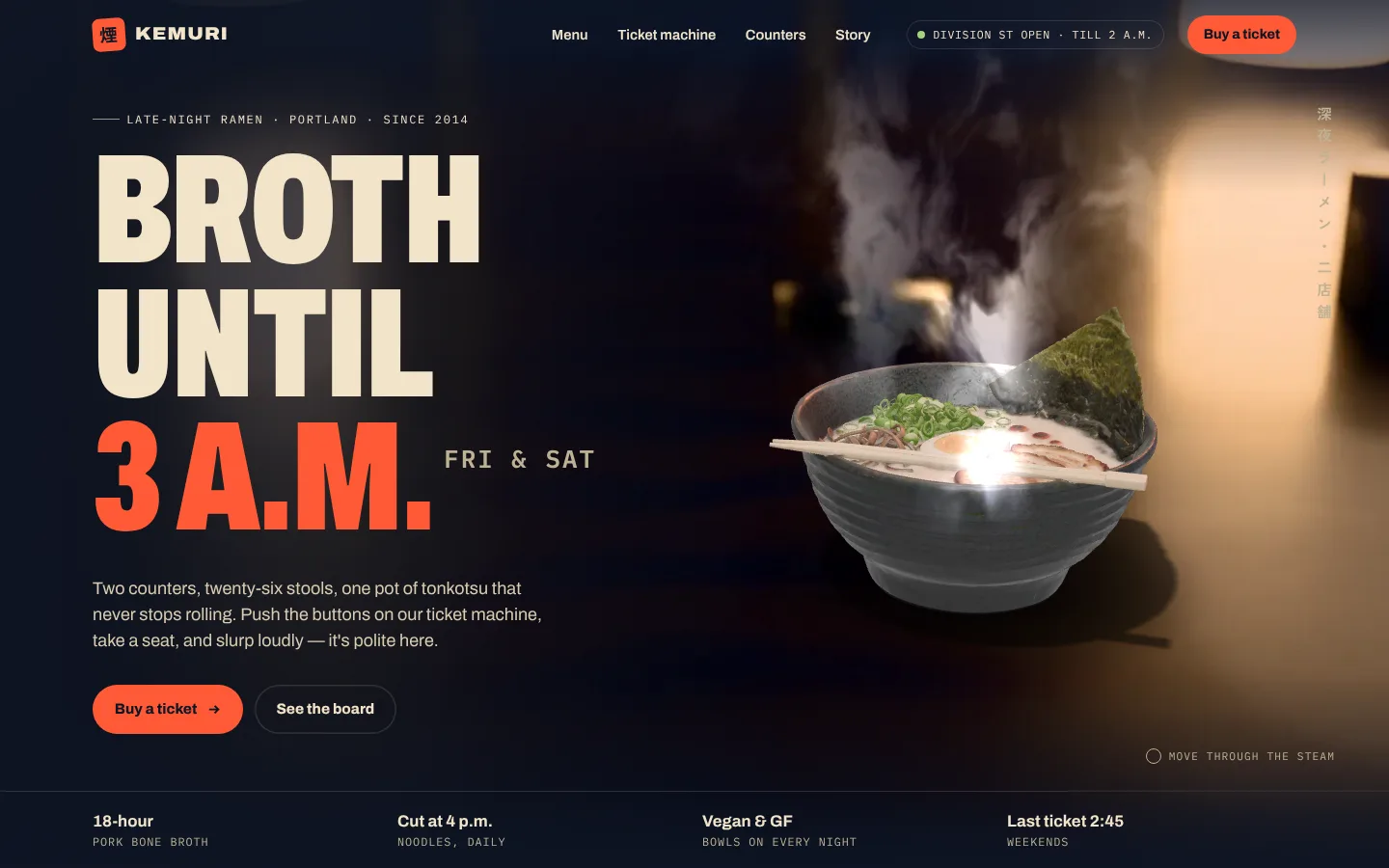
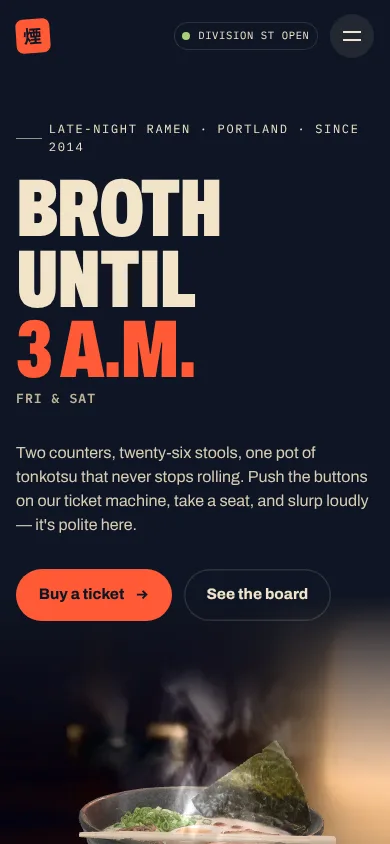
Kemuri Ramen bar with steam and a ticket machine
A late-night ramen bar: steam drifts from the bowl, you order on a meal-ticket machine and each counter shows if it is open now.
What's in the prompt
- A full written spec: layout, tokens, every animation with its numbers, responsive rules
- The complete working code as the reference implementation
- Accessibility, reduced motion and fallbacks already handled
- A “Make it yours” checklist so your site looks like nobody else’s
- Type
- Site
- Built with
- HTML, CSS, JS · three.js 0.180.0
- Prompt size
- 118 KB
- Tags
- restaurant, ordering, webgl, landing page
- Updated
- 2026-11-26
Use it in three steps
- Copy the prompt with the button above.
- Paste it into your AI (Claude, Claude Code, ChatGPT, Cursor…) and add your edits.
- Launch the single
index.htmlanywhere: Cloudflare Pages, Netlify, GitHub Pages.
About the Kemuri design
Kemuri is a one-page site for a fictional late-night ramen bar with two counters in Portland. Indigo night sections alternate with warm broth-cream blocks, with a chili vermilion accent and a scallion green that only ever means open. Archivo's width axis does a lot of work: condensed capitals for headlines and an extended wordmark in the footer, with IBM Plex Mono for prices, the LED and the ticket, and Zen Kaku Gothic New for the Japanese text. The signature has three parts: a real 3D bowl sitting in a rendered counter scene, steam the cursor can part, and a Japanese meal-ticket machine as the order builder.
The header carries a live open or closed pill and changes colour per section. The hero shows a ramen bowl in a pool of lantern light that leans toward the cursor and can be spun, with steam rising from it. The menu board lists eleven dishes with Vegan, Gluten-free and Spicy filters, and each Build this bowl button loads that bowl into the ticket machine. There, chunky keys light up as you choose broth, noodle, firmness, toppings, heat and sides, an LED shows the total, and Print ticket feeds out a numbered ticket you can download. Two locations show live hours and a queue estimate, then a kitchen video and a sign-up.
Good for
- Ramen, noodle and dumpling bars: the ticket machine mirrors how people order
- Taquerias, pho or hot-pot spots: the prompt suggests re-theming the steam and machine
- Late-night venues: the hours engine handles closing past midnight
- Multi-location restaurants: two counters each show status and queue
- Food brands with dietary rules: keys disable with a visible reason
How Kemuri is built
- GLB bowl locked to a rendered counter. A PerspectiveCamera(24, 1600/880) copies the Blender camera pose, and on every resize the plate's cover crop is written both to the img's object-position and to setViewOffset, so the ramen bowl GLB stays in the render's pool of light at any width.
- Steam the cursor can part. A half-resolution WebGL1 shader draws domain-warped 5-octave fBm steam from the bowl's projected rim; a 10-point decaying pointer trail displaces and thins it within 0.42 of the bowl radius.
- Thin-film lacquer sheen. An additive fullscreen quad adds interference colour from 4-octave fBm thickness plus a ring ripple sin(d·40−3t) at the pointer, rising from .05 to .22 under a moving cursor.
- Meal-ticket machine order builder. Real radios and checkboxes styled as lit keys feed a green LED total that rolls over 380ms; vegan broth disables pork and egg keys with a visible reason, and Tantan forces heat 2 or more.
- Printed ticket in thermal steps. Print grows the ticket clip in 22 jittered steps over about 1.5s, saves it to localStorage with a seeded barcode, and 'Keep ticket' redraws it on a 600px canvas as a PNG download.
Images, video and 3D
A Blender Cycles counter plate (1600×880), a meshopt ramen-bowl GLB made with an image-to-3D tool, an overhead fallback bowl photo, ten menu photos, two storefronts and a 5 s muted kitchen loop with poster. Shoot or generate the food photos in one top-down, single-spotlight style, convert your own dish photo to GLB, and render the counter in Blender with the exact camera numbers from the prompt.
Build it with Claude
Ask Claude for the full index.html; in the preview the bowl GLB and photos will be missing, so check the parts that run on their own: the dietary filter chips with the 'N of 11' count, the ticket machine rules (pick Forest miso and confirm chashu is disabled) and the open/closed pill computed from Portland time.
Claude guide →Build it with Claude Code
Create index.html with assets/ holding counter-plate.webp, ramen-bowl.glb, hero-bowl.webp, the menu-*.webp set, store-alder.webp, store-division.webp, kitchen-poster.webp and kitchen.mp4/.webm, then serve it with npx serve; GLB loading fails from file://. Ask Claude Code to compare the bowl's position against the plate at 390, 768 and 1440, and to print a ticket and reload to confirm the KEPT stamp appears.
Build it with ChatGPT
Ask ChatGPT for the file in sections (page and ticket machine script, the 3D bowl module, the steam shader, then CSS), or use canvas. The hours engine is a frequent follow-up: check that spans past midnight (Fri–Sat until 03:00) count as open and that before 4 a.m. the highlighted row is still the previous day.
ChatGPT guide →If it doesn’t work
- The bowl floats off the counter at some widths: apply the same crop to the plate's object-position and to camera.setViewOffset, and keep the Blender and three.js camera values identical.
- Steam appears in the wrong place or not at all: the steam shader reads window.__bowlScreen each frame and needs the y axis flipped into canvas pixels, falling back to the photo bowl's box when 3D fails.
- Ticket numbers repeat after reload: keep the counter in storage (seeded 400–479) and wrap every localStorage call in the try/catch store helper.
Questions about Kemuri
Can visitors actually order food through the Kemuri ticket machine?
No. It builds and prints a numbered ticket in the browser, saves it and lets the visitor download it as a PNG, but nothing is sent to a kitchen. You would need to connect it to your own ordering system.
How does the page know whether the bar is open?
It reads Portland time with Intl.DateTimeFormat in the America/Los_Angeles zone and checks it against each counter's opening spans, re-running every 30 seconds. The queue meter is a labelled estimate from an hourly demand curve, not live data.
Make it yours
This prompt rebuilds one exact design. If everyone ships it unchanged, the sites will look alike. Before you paste it, change these lines so the result is yours. Each change is one edit to the prompt; the structure and the interactions stay intact.
- Brand and offer. Swap Kemuri, Portland and the two counters for your own late-night food place: a pho shop, a dumpling bar, a taqueria, a hot-pot room. Keep 8–12 menu items (so the 3-column grid ends cleanly), exactly two locations, and 5 base choices in the machine's first row so the keys stay square at 1440.
- The hero object and its set. Replace the GLB with your own dish or product (photo → image-to-3D, then
gltf-transform optimize --compress meshopt --texture-compress webp --texture-size 1024). Re-render the plate in Blender with your surface: marble bar, steel counter, picnic table. Keep the camera numbers identical in Blender and three.js, or the object will float. - The steam. The steam shader is the other half of the signature. Re-theme it and keep the cursor trail. Tea house: paler, slower steam (
t·.18) over a teapot. Taqueria: warm orange smoke (coltoward(1,.7,.45)) rising off a comal. Hot pot: two plumes (twouBowlenvelopes added together). Cocktail bar: dry-ice fog that falls (flip theb.ytime sign and the envelope). - The machine. Keep the lit keys, LED and printed ticket, but change what it sells and how it looks: a pho slip with "broth / cut / herbs", a dumpling tally card, a deli number tag. Swap the cream-metal body for brushed steel, red lacquer or wood; give the LED amber or blue glow; change the ticket's mask from scallops to a straight tear. Then rewrite its rules for your food: halal/kosher keys that disable pork, a "max 2 sauces" limit, a dish that forces a minimum heat. These rules are what makes the machine feel like a real counter, not a form.
- Palette. Replace
--ink,--brothand--chiliwith your own night/day/accent trio, and--negiwith your "open" colour. Keep accent text on the light surface ≥ 4.5:1 (darken it like--chili-deep) and ink text on the accent button ≥ 4.5:1. - Type pairing. Swap Archivo's condensed/extended axis for another variable grotesk with a width axis (e.g. Bricolage Grotesque, Anybody, Big Shoulders), keep a mono for every price and ticket line, and use the script your cuisine uses for the decorative glyphs (Noto Sans KR, Noto Sans Thai, or none).
- Photos. Regenerate the overhead set in one consistent art direction — top-down, your own surface colour, one warm spotlight, no text — and keep the hero dish centred with a dark edge so the 3D fallback's circular mask still lines up. Replace the two storefronts and the kitchen loop with your own places.
- Copy. Rewrite the headline and every label in your own late-night voice: what time you close, what you are known for, how people actually order.
Tell your AI: "Build exactly as specified, but with these changes: …", then list your edits.