Site · 3D & WebGL
Caldera Scroll descent into a volcanic crater
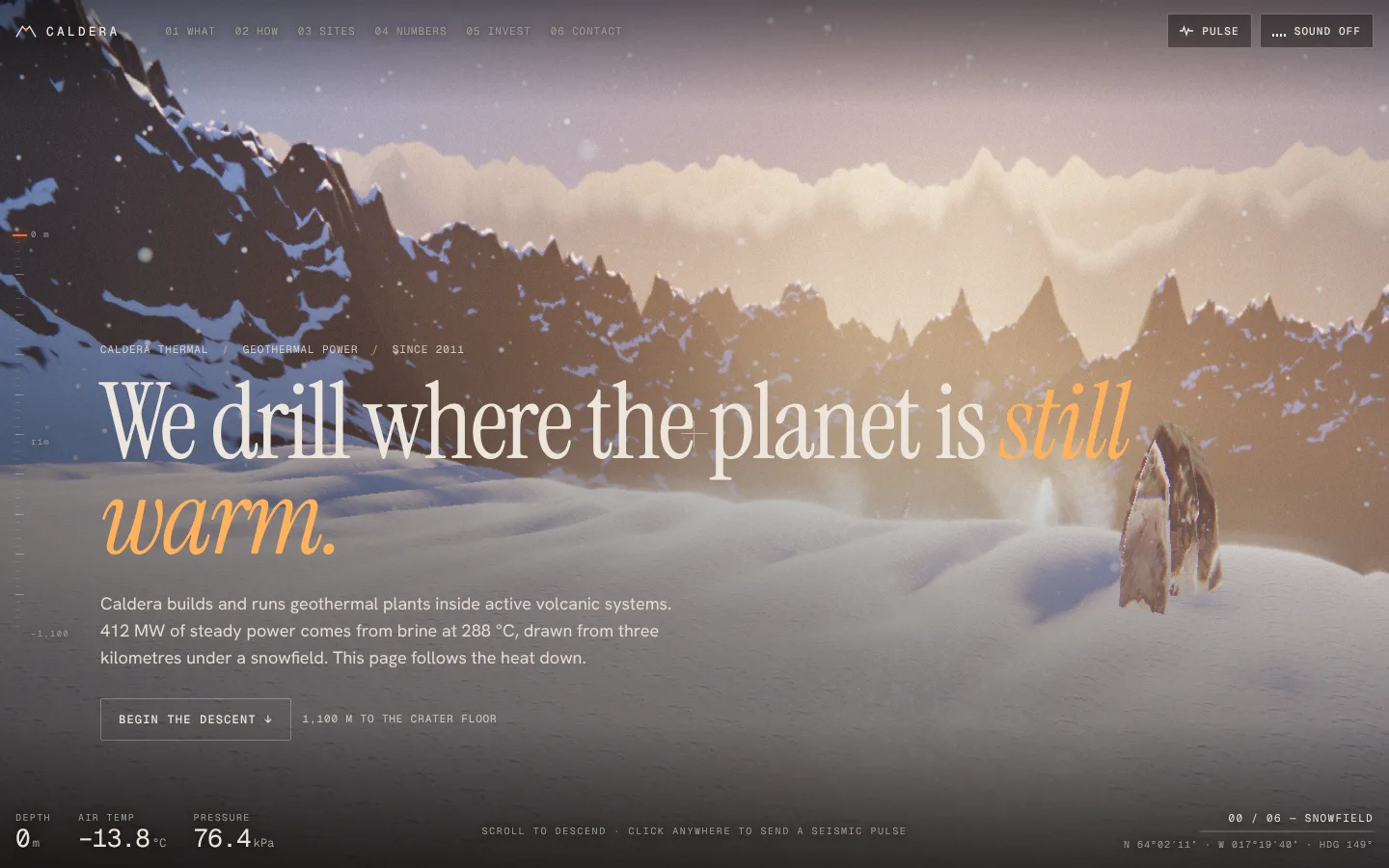
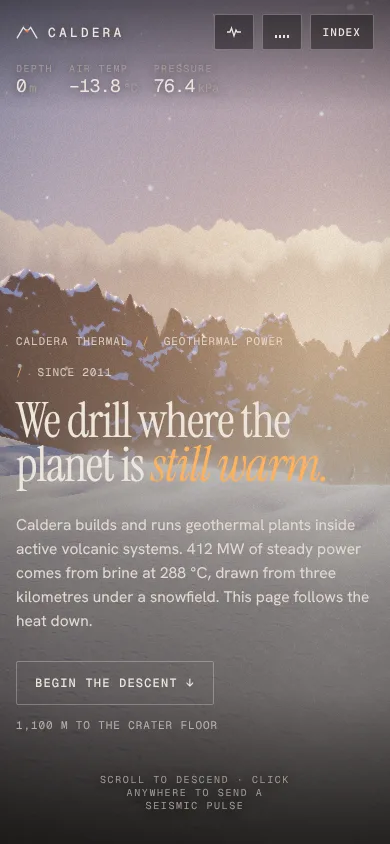
One continuous WebGL world: scroll flies from a snowfield down into a crater of obsidian glass, lava light and steam.
What's in the prompt
- A full written spec: layout, tokens, every animation with its numbers, responsive rules
- The complete working code as the reference implementation, also as a ready-to-run .zip with every image, video and 3D model
- Accessibility, reduced motion and fallbacks already handled
- A “Make it yours” checklist so your site looks like nobody else’s
- Type
- Site
- Built with
- HTML, CSS, JS · three.js 0.170.0
- Prompt size
- 121 KB
- Tags
- three.js, scroll storytelling, webgl world, energy
- Updated
- 2026-11-26
Use it in three steps
- Copy the prompt with the button above.
- Paste it into your AI (Claude, Claude Code, ChatGPT, Cursor…) and add your edits.
- Launch the single
index.htmlanywhere: Cloudflare Pages, Netlify, GitHub Pages.
About the Caldera design
Caldera is a one-page site for a fictional geothermal company, Caldera Thermal. The page is one continuous three.js world, and scroll flies the camera through it in a single shot: dawn over a high snowfield, down a slope of sulphur-stained fumaroles, over a caldera rim where snow turns to ash and embers, and down to a power plant on a crater floor of cracked basalt with lava in the seams. The palette is ink, bone and one ember orange. Instrument Serif sets the headlines, Hanken Grotesk the body and Geist Mono the HUD, which reads depth, air temperature and pressure live from the camera.
The descent stops at seven designed shots along a 1050vh track. Six content panels are real HTML sections pinned beside 3D anchor points, and their titles decode from glyph noise as they arrive. Clicking anywhere sends a seismic pulse: the camera shakes, the lava cracks flare, a ring travels across the floor and through the steam, the synthesised soundtrack thumps and the HUD logs the event. The panels hold a four-step plant slider, site tabs, counting stats, Invest and Careers tabs and a validated contact form. Reduced motion or no WebGL2 gives a still-frame page with the same content.
Good for
- Energy and mining companies: the descent shows where the resource sits and the HUD gives real units
- Deep-tech or infrastructure firms: one continuous world suits a story told in stages
- Expedition or research outfits: the five-act path (open, slope, threshold, interior, destination) can be re-themed
- Investor pages: an Invest tab, a 2×2 stat grid and a contact form sit inside the scene
- Recruiting microsites: Apply buttons prefill the contact form and fly the camera to it
How Caldera is built
- One height function for everything. A single JS
height(x,z)built from seeded gradient noise (a domain-warped ridged multifractal for the ranges, gullies on the slope, a rim ridge at r 540 and a bowl inside r 280) shapes the 4800×5000 terrain mesh, keeps the camera at least 16 units above ground and ray-marches the pulse epicentre. - Cellular lava crust. The crater floor uses Voronoi plates about 30 units across with exact edge distance plus a second crack network near the seams; emission ramps from black crust through deep red (×2.5) and orange (×4.5) to a white-yellow core (×9), and bloom (threshold 1.7) picks up only the lava, sun and embers.
- Obsidian with dispersion. About 36 instanced glass blades refract a half-resolution opaque render with separate IORs per channel (1.46, 1.50, 1.555), plus thickness-based absorption, Fresnel sky reflection and a thin-film sheen.
- Tiered steam and snow. 360k, 220k or 120k GPU steam points across 10 vents and 42k, 28k or 14k camera-wrapped flakes that turn from snow to ash to embers, with tiers chosen from pointer type, viewport and core count.
- Readiness and adaptive pixel ratio. The preloader logs real steps, runs
renderer.compileAsyncand three warm frames of the full post chain, and the pixel ratio drops by 0.2 (to a floor of .65) after 1.5 s above 26 ms per frame.
Images, video and 3D
A 1.5 MB GLB of the geothermal plant made with an image-to-3D tool from a generated studio product shot (quantised geometry, 1024px JPEG textures), two CC0 scanned rock meshes instanced as the obsidian blades, CC0 basalt and snow textures, and four WebP stills rendered from the live scene for the fallback page. The sky, fog, lava and sound are all procedural. To make your own, swap the plant for your hero object generated from a clean product photo and re-render the four stills from your scene.
Build it with Claude
Ask Claude for the full index.html. three.js is loaded with dynamic import(), so if it fails, or the preview has no WebGL2, the page falls back to the still-frame layout and every panel still works. In the preview, check that the stage slider steps through Well, Separator, Turbine and Reinject, that the site tabs answer to arrow keys, that an Apply button prefills the contact form, and that the form asks for a name of at least 2 characters, a complete email and a 20-character message.
Claude guide →Build it with Claude Code
Put plant.glb, shard-a.glb, shard-b.glb, the three textures and still-1 to still-4.webp in assets/ and serve with python3 -m http.server, since the GLBs cannot load from file://. Ask Claude Code to open the page headlessly with ?static to test the still-frame path, then with WebGL to confirm the preloader reaches its warm-frames step, that the P key sends a pulse, and that there is no horizontal scroll at 390, 768 and 1440.
Build it with ChatGPT
Ask ChatGPT for the page in parts, or in canvas, since it is long: the HTML, CSS and UI script, the height function and terrain shader, the lava, obsidian and steam shaders, then the post chain and Web Audio. A common follow-up is the camera: check that it follows the seven shot positions on the two Catmull-Rom curves with per-segment easing, or it will drift past the panels instead of settling on each one.
ChatGPT guide →If it doesn’t work
- The camera clips through a ridge between shots: clamp its height with the same
height()function the terrain mesh uses, at least 16 units above the surface. - Everything glows once bloom is on: keep the bloom threshold at 1.7 so only HDR lava, the sun and embers pass it, and keep the plant's pipes matte.
- Steam is missing inside the glass blades: that is expected, because the refraction buffer holds only opaque geometry, so do not draw the steam into it.
Questions about Caldera
What do visitors without WebGL2 see on the Caldera page?
With no WebGL2, reduced motion or ?static, the page switches to a still-frame layout: a sticky header, the hero over a still rendered from the scene, and each panel in normal flow over its own still. All tabs, sliders and the form still work, and the sound still changes by section.
Does Caldera use audio files?
No. The wind, the low rumble and the pulse thump are synthesised with Web Audio, so the sound adds no download. It starts only after the visitor picks Descend with sound or makes a first gesture, and the mute choice is remembered.
Make it yours
This prompt rebuilds one exact site. If everyone ships it unchanged, the sites will look alike. Before you paste it, change these lines so the result is yours. Each change is one edit to the prompt; the structure and the interactions stay intact.
- Brand and offer. Swap Caldera Thermal for your own company (a mine, a winery in a quarry, a data centre in a glacier, a deep-sea cable firm). Keep six panels, one number-heavy panel with four stats, and one form, so the stops along the 1050vh track stay evenly spaced.
- The descent. Re-theme the journey and keep the one continuous camera path: down a kelp forest to a trench vent, down a mine shaft to a crystal cavern, through cloud to a desert canyon floor. Change
height()(plateau, rim, bowl), the snow line and the crack emission ramp to suit, and keep the five-act structure (open, slope, threshold, interior, destination). - The pulse. Keep "click sends something through the world" but make it native to your story: a sonar ping that lights bioluminescence, a blast charge that shakes dust loose, a lightning strike that flashes the clouds. Reuse the same ring, shake, flare and thump parameters.
- Palette. Replace the ink, bone, ember and sulphur tokens, the sky horizon and zenith, and the two fog colours. Keep bone text at ≥ 4.5:1 on ink, and keep one hot accent for emission so the bloom threshold still isolates it.
- Type pairing. Swap Instrument Serif + Hanken Grotesk for another display serif or grotesk with a plain body face, and keep a true monospace for the HUD (JetBrains Mono, IBM Plex Mono, Space Mono).
- Assets. Replace the plant GLB with your own hero object (studio product shot → image-to-3D, then quantise and use 1024 textures, ≤ 1.5 MB). Pick different CC0 rock or ground scans for the terrain and glass blades. Re-render the four stills from your own scene.
- HUD readings. Choose three live values that mean something in your world (depth, salinity and lux for the ocean; altitude, wind and visibility for a summit) and drive them from the camera, as depth, temperature and pressure are driven here.
- Copy. Rewrite every headline in your own voice with real specifics ("brine at 288 °C", not "unlock clean energy").
Tell your AI: "Build exactly as specified, but with these changes: …", then list your edits.