✦ Members Site · Scroll storytelling
Atlas Run Trail race event site on a scroll-scrubbed course film
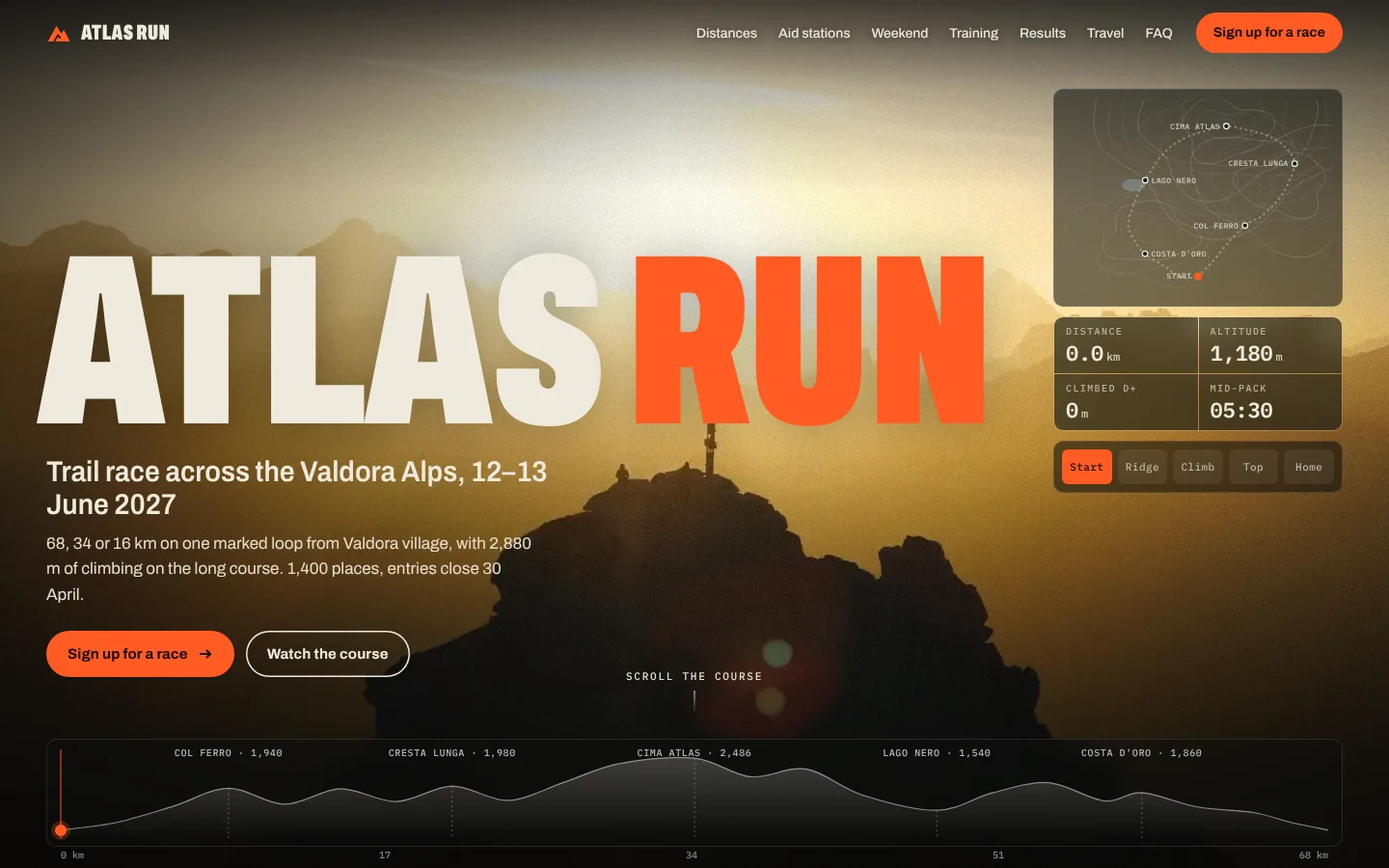
A mountain trail race where scroll flies the 68 km course with a live map, elevation profile and race clock over the film, plus registration, training plans and results. Bring your own video.
Unlock free with your emailPrompt 120 KB · code .zip 1.8 MB
Members
Unlock the prompt, demo and code
Free with your email. We send a confirm link; it unlocks every Members template on this browser.
Check your inbox
We sent the unlock link to . Open it in this browser and every Members template unlocks.
Nothing after a few minutes? Look in spam or promotions. Wrong address?
Unlocked on this browser
What's in the prompt
- A full written spec: layout, tokens, every animation with its numbers, responsive rules
- The complete working code as the reference implementation, also as a ready-to-run .zip with every image, video and 3D model
- Accessibility, reduced motion and fallbacks already handled
- A “Make it yours” checklist so your site looks like nobody else’s
- Type
- Site
- Built with
- HTML, CSS, JS · no libraries
- Prompt size
- 120 KB
- Tags
- trail running, event, scroll video, registration, bring your own video
- Updated
- 2026-11-28
Use it in three steps
- Unlock it free with your email, then copy the prompt.
- Paste it into your AI (Claude, Claude Code, ChatGPT, Cursor…) and add your edits.
- Launch the single
index.htmlanywhere: Cloudflare Pages, Netlify, GitHub Pages.
About the Atlas Run design
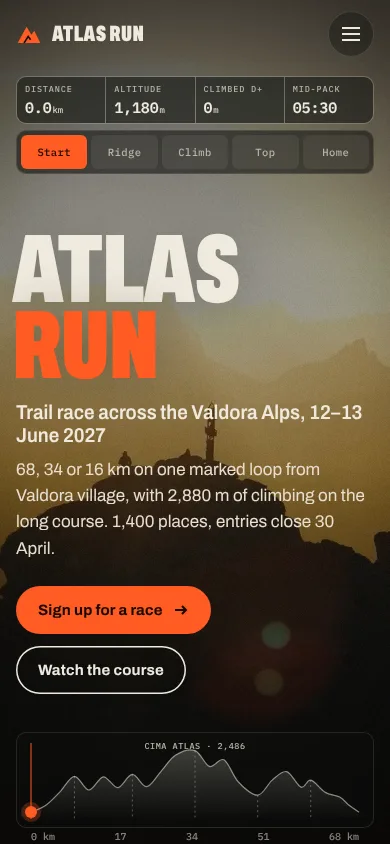
Atlas Run is a full event site for a fictional mountain trail race on one marked loop from Valdora village: 68, 34 or 16 km on 12–13 June 2027, with 1,400 places. The palette is granite dark and chalk paper with one race-bib orange accent and a lichen green for counts and easy weeks. Archivo, a variable font, sets the condensed uppercase display at its narrow width and the body at normal width, and IBM Plex Mono sets every number. The signature is a 720vh section with a sticky aerial film scrubbed by scroll along the route, from first light to the evening finish: scrolling down moves the runner forward and scrolling up moves them back.
Over the film run a topo route map whose orange marker draws the finished route, an elevation profile that fills in to the current kilometre, four live counters (distance, altitude, metres climbed and a mid-pack race clock), five chapter reveals and chapter buttons. A WebGL pass adds a chromatic fringe, a speed blur that follows scroll velocity, a vignette and grain. Below come distance cards with a cut-off table, a filterable aid-station list, the race weekend, registration with a live fee and validation, a training plan by weeks, results from three editions with search and derived records, travel, an FAQ and a closing photo. The page is about 20.6 screens at 1440. You supply the footage; without it, five original stills run the same story.
Good for
- Trail races, ultras and mountain marathons: the map, profile and counters all come from your course's elevation table
- Gravel rides, coastal ultras and hut-to-hut hikes: swap
PROFILEandMAPXYand the climb, clock and cut-offs recalculate - Events that take entries online: registration handles distances, shirts, extras, guests, age rules and a qualifier
- Races with a results archive: tabs, a distance filter and name search, with records computed from the results
- Organisers who publish training advice: the plan generates weeks and sessions for three distances and two levels
How Atlas Run is built
- One elevation table drives everything. A
PROFILEarray of 24[km, altitude]points (1,180 m at the start, 2,486 m at km 34) feeds the map, profile, preloader line, mini profiles and counters. Climb so far sums positive steps (2,880 m in total), and the clock is 05:30 + 7.2 min per km + 1 min per 10 m up + 0.3 min per 10 m down. - Exact map position at every checkpoint. The route is a Catmull-Rom curve through
MAPXY. The path is sampled once to find the length at every vertex, so km maps to a map point exactly at each checkpoint withgetPointAtLength, and the finished route draws bystroke-dashoffset. - Speed blur from scroll velocity. The post pass takes six taps toward the centre (
k = i/5 · vel · .022), offsets red and blue outward by.0015 + vel·.0035, and adds a vignette and hashed grain.velrises at .15 per frame and falls at .35, so the blur decays faster than it builds; DPR is capped at 1.25 (1 under 820px). - Seek-safe scrub with keyed timing. Scroll progress eases with
1 − e^(−7·dt)and maps throughCONFIG.filmKeysto film seconds. The MP4 streams into a Blob with real byte progress (film 80%, fonts 10%, poster 10%); one seek is in flight, the newest target runs onseeked, and seeks under 1/40 s are skipped. - Generated training plan. Every fourth week and the week before race week are easy, the last week is race week, and build weeks ramp from 50% to 100% of the peak (Atlas 70/95 km, Ridge 48/66, Valley 30/42 by level). Week bars are
aria-pressedbuttons that arrow keys move between, and sessions are generated from each week.
Images, video and 3D
The download includes eight original photographs made with an AI image generator as one set, plus 960px variants and a grain tile (14 files, about 1.9 MB): five film-fallback stills in course order (dawn summit, ridge, switchback climb, plateau, evening ridge), the aid station, the finish line and the valley railway. The aerial film in the live demo is licensed stock footage for the demo only, so it is not in the download or the prompt. You supply your own: atlas-1920.mp4 (1920×1080, 18–25 s, 12–15 fps, all-intra), a 720×1280 portrait cut cropped from the source and a WebP poster for each, placed in assets/film/ with CONFIG.filmKeys set to your shots. The prompt has the exact ffmpeg commands, or use the free encoder at /tools/scroll-video-encoder/. Until then the page runs on the photographs. Members template: unlock free with your email.
Build it with Claude
Ask Claude for the full index.html in one pass. The preview has no film, so the stills path runs (the photos appear once the assets folder sits next to the file) and the map, profile, counters and chapter buttons still follow scroll. Check that Enter the 68 km preselects that distance in the form, that Ridge or Valley disables the drop bag and hides the qualifier, that the guest stepper stops at 6, and that a runner under 18 is rejected for the 68 km.
Claude guide →Build it with Claude Code
Encode your drone clips with /tools/scroll-video-encoder/ (every frame a keyframe), put them in assets/film/, point CONFIG there and set filmKeys so each chapter lands on its own shot. Serve with python3 -m http.server. Ask Claude Code to scroll headlessly and confirm the counters reach 68 km and 2,880 m climbed at the end, then run it without the film, with reduced motion and with WebGL off, and check each path has no script errors or sideways scroll.
Build it with ChatGPT
Ask ChatGPT for the page in parts, or in canvas: the HTML and CSS, the PROFILE data with the map and profile, the film loader and scrub, the WebGL pass, then distances and aid stations, registration, the training plan and results. A common follow-up is the map marker: check that it samples the path length at every vertex, or the marker will miss the checkpoints on a curved route.
If it doesn’t work
- Scrubbing steps on a fast fling: every frame must be a keyframe, so re-encode with /tools/scroll-video-encoder/ or
-g 1 -keyint_min 1in ffmpeg. - The film file goes well over 10 MB: grass and scree are expensive in all-intra video, so lower the frame rate before raising the CRF, or soften the busiest shot.
- Chapters show the wrong shot after you swap footage: set
CONFIG.filmKeysso each chapter's progress range maps to its own shot's seconds. - Counters and map disagree after you change the course: replace
PROFILEandMAPXYtogether, with the same number of points in the same order.
Questions about Atlas Run
Is the Atlas Run course film included in the download?
No. The aerial film in the live demo is licensed for the demo only, so the download leaves it out and opens on the course photographs. Supply your own: a 1920×1080 all-intra MP4, a 720×1280 portrait cut and a poster for each, then point CONFIG at them. The prompt has the ffmpeg commands, and /tools/scroll-video-encoder/ makes clips scroll-ready.
What footage works best for the course film?
Four to six drone shots of 3–5 s each in course order (sunrise, a ridge, a climb, the high point, evening), each one slow, steady move with runners small in frame, no cuts inside a shot and no text. Grade them to one look and join them with 0.5 s crossfades.
Does registration take real entries?
No. It validates every field, updates the fee live and returns a reference that starts with AR27 and the distance letter, and the places-left count drops by one, but nothing is posted to a server. Connect it to your entry system before launch.
Are the results and records real?
No. Each edition has seeded times for 14 runners per distance, the table shows the top 10, and the records are computed from those results so they always agree. The footer says the race, people, prices, times and results are invented.
What happens on phones, with reduced motion or without JavaScript?
Phones get the portrait cut, a full-width HUD band without the map, and a 96px profile. With reduced motion the film holds one frame per chapter with no speed blur and lighter grain. Without JavaScript nothing is hidden: the hero and every section render with the stills behind the hero.
Make it yours
Everyone who pastes this gets the same race unless they change it. Make these edits first. Each one keeps the structure and the interactions.
- Event and course. Rename Atlas Run, Valdora and the six checkpoints, and replace
PROFILEandMAPXYwith your own route: a gravel ride, a coastal ultra, a hut-to-hut hike or a ski-touring race. Keep 15–30 profile points and 5–7 named checkpoints. Everything else (D+, clock, map, profile, cut-offs) recalculates from them. - The film. The scrubbed film is the signature, so film or source your own course in order: harbour start to cliff path to lighthouse, forest gravel to pass to lake, or valley to glacier to hut. Keep one camera move per shot and the light changing across the day, so the clock means something.
- HUD readouts. Swap the four counters for what your event measures: speed, gradient, temperature, sunrise countdown or calories. Keep four cells, mono figures and one moving marker on the map.
- Palette. Replace
--signalwith your race colour, and keep it the only accent on the film. Replace the granite and chalk pair with your own dark and light grounds, and keep--muteat 7:1 and--signal-inkat 4.5:1 on paper. - Type pairing. Swap Archivo's condensed width and Plex Mono for another variable grotesk with a narrow axis and a mono, such as Barlow Condensed with Barlow and DM Mono, or Big Shoulders Display with Public Sans and JetBrains Mono. Keep the display uppercase and every number in mono.
- Photos. Regenerate the five stills, the aid table, the finish line and the travel photo as one set from your own region: same drone height, same light, same grade. The stills must follow the film's shots in order, because they are the fallback film.
- Copy voice. Write every chapter as what happens at that kilometre ("km 24 → 30 · 670 m up in six km, poles allowed from here"), not as mood. Keep distances, times and prices specific, and keep the footer line that says they are fictional until they are real.
"Build exactly as specified, but with these changes: …"
Commissions
Want Atlas Run for your brand?
We build it for you: your story, your copy, motion made for your brand, live on your domain. Two projects a month, so each one gets the same care as this template.
- A cinematic site made for your brand, not a reskin
- Original motion and imagery made for your story
- Fast on phones, accessible, yours to keep
Thank you. We have it.
We read every inquiry ourselves and reply from hello@copytheprompt.design within two working days. Add that address to your contacts so the reply doesn’t land in spam.