Site · Scroll storytelling
Halfmoon Record crate you flick through by scrolling
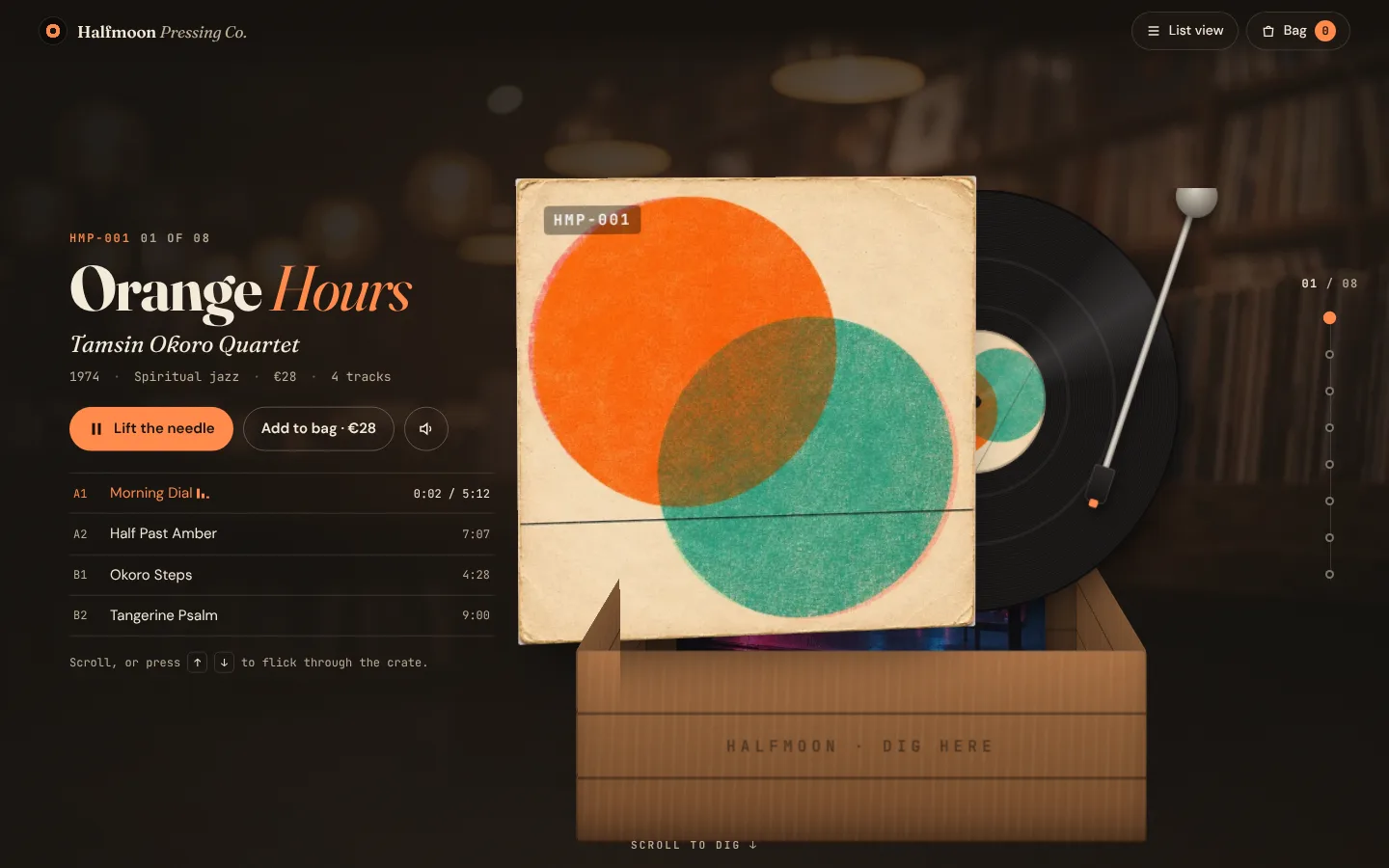
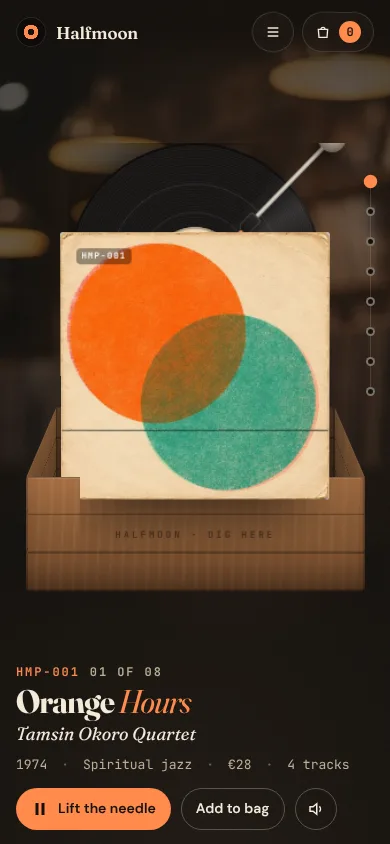
A record label shop built around a CSS-3D crate of LPs. Each record lifts out, its vinyl slides from the sleeve and the needle drops.
What's in the prompt
- A full written spec: layout, tokens, every animation with its numbers, responsive rules
- The complete working code as the reference implementation
- Accessibility, reduced motion and fallbacks already handled
- A “Make it yours” checklist so your site looks like nobody else’s
- Type
- Site
- Built with
- HTML, CSS, JS · no libraries
- Prompt size
- 70 KB
- Tags
- scroll animation, css 3d, music, e-commerce
- Updated
- 2026-11-26
Use it in three steps
- Copy the prompt with the button above.
- Paste it into your AI (Claude, Claude Code, ChatGPT, Cursor…) and add your edits.
- Launch the single
index.htmlanywhere: Cloudflare Pages, Netlify, GitHub Pages.
About the Halfmoon design
Halfmoon Crate Digger is a one-page record shop for a fictional independent label, built around the feeling of flicking through a wooden crate. It is pure CSS 3D with no WebGL. The ground is a dark walnut ink with paper-cream text, and each record sets its own accent colour, drawn from its cover, which re-tints the logo, rail and play button as you dig. Fraunces gives titles a warm, slightly vintage voice, DM Sans keeps the body plain and JetBrains Mono carries catalogue numbers and track times.
A visitor scrolls and the front record lifts out of the crate on an arc, its black vinyl slides out of the sleeve, then it drops forward onto the pile of records already passed. The left column always shows the held record's catalogue number, artist, year, genre, price and tracklist. Drop the needle swings a tonearm onto the disc and runs a track timer, and an optional Sound button plays a soft synthesised chord with crackle. A tick rail on the right jumps to any record, a bag handles add, remove and reserve, and a Listening Club form closes the page. A header toggle switches to a flat list view of the same records.
Good for
- Record shops and labels: the crate maps directly to browsing physical stock
- Musicians releasing an album: each track or edition can be a sleeve
- Bookshops: the prompt suggests books sliding out of slipcases
- Wine or spirits sellers: a bottle can slide out of its box instead of a disc
- Print and poster studios: prints can be pulled from portfolio sleeves
How Halfmoon is built
- Scroll-pinned CSS 3D crate. The crate section is 100 + (N−1)·70 vh tall with a sticky 100svh pin; eight square sleeves are positioned with translate3d and rotateX/rotateY inside a preserve-3d deck, with wood panels for the front, sides and back of the crate.
- Flick-lift-drop pose curve. Each record's pose depends on p = i − progress: the held record sits at z .98S, records behind tilt back 9° plus 3.2° per step, and passed records lean forward −38° onto the pile, with an extra arc of .42·sin(π·u) so they clear the crate wall.
- Dwell-eased scroll progress. Raw scroll maps through dwell(x) = n + smoothstep(.19, .81, x − n) so each record holds for a moment, then progress chases the target with 1 − e^(−9·dt); the rAF loop only runs while it is settling and the section is on screen.
- Disc pull and tonearm. Near the crest the vinyl slides out by .5·S sideways on desktop or −.36·S upward on phones; Play spins it at 1.8s per turn (33⅓ rpm) and swings the tonearm from rest to play over .9s.
- Synthesised sound, off by default. Pressing Sound creates an AudioContext with four detuned oscillators at root × (1, 1.26, 1.5, 2) through a 900 Hz low-pass, plus a looped crackle buffer, gliding to a gain of .05.
Images, video and 3D
Eight 720×720 WebP album covers with no text in the art, plus a 1600×900 out-of-focus record-shop backdrop. Generate a consistent cover series with an AI image tool or use real artwork you have the rights to; if a cover is missing, the code draws a procedural sleeve from the record's colours.
Build it with Claude
Paste the prompt and ask for one index.html; since it uses only CSS 3D and Web Audio, the claude.ai preview can show the full scroll crate (covers fall back to procedural sleeves without your images). Scroll slowly to check that each record lifts over the front wall rather than through it, then press Drop the needle and Sound to confirm the tonearm and audio start only on request.
Claude guide →Build it with Claude Code
Make a folder with index.html and assets/ holding the eight numbered cover WebPs and shop-backdrop.webp, and ask Claude Code to build from the prompt. It runs from file:// as well as over a local server; ask it to use the exposed window.__crate.goTo(i) hook in a headless browser to step through all eight records at 390 and 1440 and check there is no horizontal scroll.
Claude Code guide →Build it with ChatGPT
Ask ChatGPT to deliver the file in parts or in canvas, because the pose maths and the audio graph are long. A common follow-up is the pose curve: check that the shade is a child layer's opacity, not a CSS filter on the 3D element, and that reduced motion opens the list view instead of the crate.
ChatGPT guide →If it doesn’t work
- Sleeves flicker or render flat: never put filter on preserve-3d elements; darken them with the .sleeve__shade layer's opacity as the spec does.
- Records pass through the crate's front panel during the flick: keep the front at translateZ(.78S) and about .44S tall, and include the −.42·sin(π·u) arc in y.
- Arrow keys trap the user inside the crate: at the first and last record the key must fall through to normal page scrolling, and keys are ignored while focus is in a form field.
Questions about Halfmoon
Does the Halfmoon crate play real music?
No. Playback is simulated with a spinning disc and a track timer. If the visitor turns Sound on, the page synthesises a soft chord with vinyl crackle using Web Audio; there are no audio files.
What do visitors see if their browser lacks CSS 3D or prefers reduced motion?
They get a flat list view of the same eight records with the same Play and Add to bag buttons. Reduced-motion users start in that list and can still switch to the crate, where progress snaps instead of easing.
Make it yours
This prompt rebuilds one exact design. If everyone ships it unchanged, the sites will look alike. Before you paste it, change these lines so the result is yours. Each change is one edit to the prompt; the structure and the interactions stay intact.
- Label and catalogue. Swap "Halfmoon Pressing Co." and the eight records for your own label, shop or artist: titles, artists, years, genres, prices and 4–5 tracks each. Keep 6–10 records (fewer feels empty, more makes the scroll track tiresome) and two-word titles where the second word can go italic in the accent.
- What comes out of the sleeve. The pulled disc and tonearm are the signature. Keep the lift-hold-drop cycle and the "pull" (
--ox/--oy) but change what is pulled: a cassette from its J-card case, a CD from a jewel case (shorter slide, rainbow sheen instead of grooves), a print from a portfolio sleeve, a book from a slipcase, a wine bottle from a wooden box. Replace "Drop the needle" with the matching action (press play, open, pour). - The crate. Re-skin the container, not the geometry: a metal flight case with corner brackets, a cardboard banana box with a printed logo, a lacquered drawer, a library card catalogue. Keep the front panel at z .78S and ~.44S tall so the held item still clears it.
- Palette. Replace the walnut ground (
#16120e), paper (#f3ead9) and wood ramp with your own, and set one accent per item drawn from its cover. Keep--mutedat ≥ 4.5:1 on the ground and dark text on every accent (check light accents like lime and yellow). - Type pairing. Swap Fraunces + DM Sans + JetBrains Mono for another expressive display face with an italic, a plain sans and a mono (for example Instrument Serif + Inter Tight + IBM Plex Mono, or Bricolage Grotesque + Manrope + Space Mono).
- Covers and backdrop. Generate your own square covers in one consistent series (one medium or one photographer's eye works better than eight random styles), no text in the art, ≤ 120 KB each at 720px WebP; regenerate the backdrop as an out-of-focus photo of your own space (studio, shop, venue) with a dark lower half.
- Sound and copy voice. Change the synth chord to your genre (lower root and saw waves for techno, sparse sine bells for ambient) or drop the Sound button; rewrite the club pitch, bag messages and hint line in your own voice, specific to what you sell ("first dibs on test pressings", not "exclusive perks").
Tell your AI: "Build exactly as specified, but with these changes: …", then list your edits.