✦ Members Site · 3D & WebGL
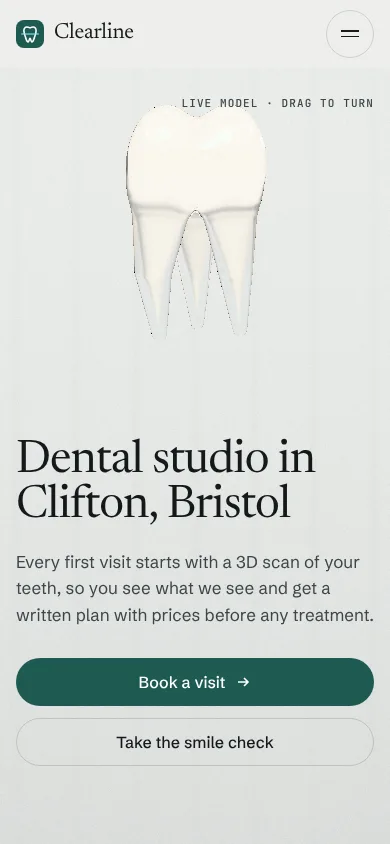
Clearline Dental clinic site with a live 3D glass tooth scan
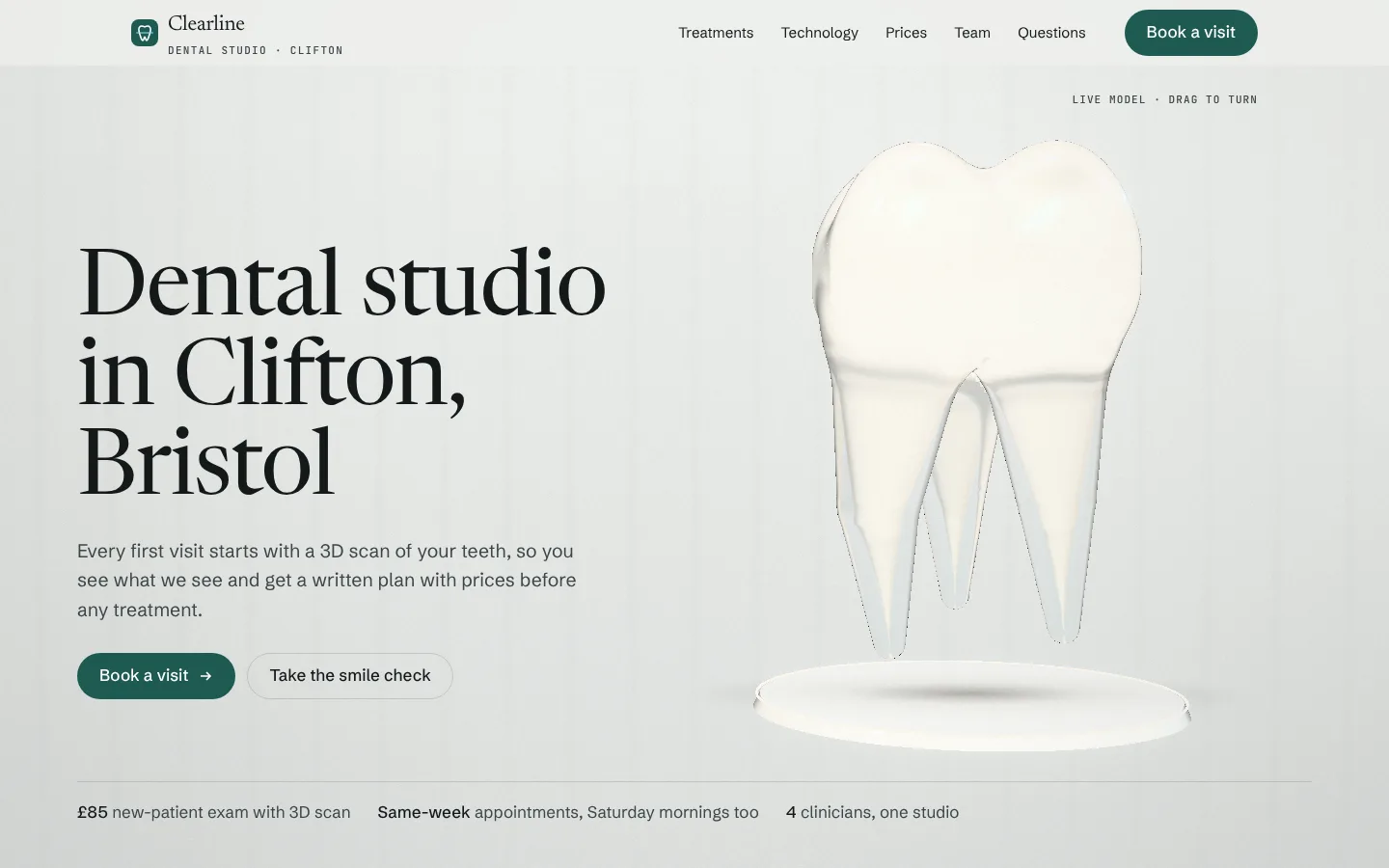
A dental studio where a procedural glass tooth turns in the hero and scroll scans it into an X-ray and a labelled cross-section, with working booking and prices.
Unlock free with your emailPrompt 109 KB · code .zip 0.6 MB
Members
Unlock the prompt, demo and code
Free with your email. We send a confirm link; it unlocks every Members template on this browser.
Check your inbox
We sent the unlock link to . Open it in this browser and every Members template unlocks.
Nothing after a few minutes? Look in spam or promotions. Wrong address?
Unlocked on this browser
What's in the prompt
- A full written spec: layout, tokens, every animation with its numbers, responsive rules
- The complete working code as the reference implementation, also as a ready-to-run .zip with every image, video and 3D model
- Accessibility, reduced motion and fallbacks already handled
- A “Make it yours” checklist so your site looks like nobody else’s
- Type
- Site
- Built with
- HTML, CSS, JS · three.js 0.170.0
- Prompt size
- 109 KB
- Tags
- dental clinic, three.js, 3d model, scroll animation, booking
- Updated
- 2026-11-28
Use it in three steps
- Unlock it free with your email, then copy the prompt.
- Paste it into your AI (Claude, Claude Code, ChatGPT, Cursor…) and add your edits.
- Launch the single
index.htmlanywhere: Cloudflare Pages, Netlify, GitHub Pages.
About the Clearline design
Clearline is a full website for a fictional private dental studio in a Georgian townhouse in Clifton, Bristol. The palette is cool porcelain paper (#edefec) and ink with one deep spruce accent (#1e5a52), plus a dark scan room for one chapter. Newsreader sets the headings, Schibsted Grotesk the body and JetBrains Mono the labels, prices and readouts. The signature is a live glass tooth: a lower molar modelled in the browser from signed distance fields (crown, four cusps, a fissure, three curved roots, with dentin and pulp as separate fields) and meshed with surface nets in a Web Worker. It is rendered with MeshPhysicalMaterial transmission over an ivory dentin core on a porcelain plinth, so the glass reads as a clear rim over an ivory core rather than solid crystal. It turns slowly, leans toward the cursor on a spring and can be dragged.
Scrolling into the 420vh technology chapter darkens the room. A glowing scan plane wipes down the tooth and turns it into an X-ray (fresnel glow, scan lines, a wireframe and an amber pulp), then a second plane wipes back up and leaves a cut-away cross-section of enamel, dentin, pulp chamber and root canals, with four labels pinned to the model by camera projection. Bloom, grain, vignette and a slight chromatic shift run as post. The rest is working clinic UI: a six-treatment explorer, a before/after smile slider with two cases, a four-question smile check, prices with a member toggle, four team cards, booking with real free slots and a calendar file, a monthly-payment calculator, an FAQ and today's hours. Twelve sections, about 15 screens at 1440.
Good for
- Private dental practices and orthodontists: the scan chapter explains enamel, dentin and pulp before the visitor reaches prices
- Clinics that take bookings online: slots follow each clinician's working days, skip lunch and hide times under two hours away
- Practices with a membership plan: one toggle re-renders four price tables with 10% off treatment and routine care included
- Cosmetic dentistry: the before/after slider and the smile check both end on a booking for the matching treatment
- Any clinic or lab with one object to explain (an implant, a joint, a lens): the prompt shows how to model another subject with the same mesher and wipes
How Clearline is built
- Procedural tooth from signed distance fields. The crown is a rounded box (0.68 × 0.36 × 0.6, r 0.3) smooth-unioned (k 0.2) with four cusp spheres, a pit and fissure smooth-subtracted, and three roots as two-segment tapered capsules (radii 0.3 → 0.19 → 0.075). Dentin is the same field offset inward by
0.085 + 0.12·smoothstep(0,.55,y), so enamel is thicker at the cusps. Surface nets run in a Web Worker on a 0.02 grid (0.028 for dentin, 0.8× density on phones and four-core machines) and the buffers are transferred back. - Two scroll-scrubbed clipping wipes. World-space clipping planes move with scroll progress p through the chapter. Wipe A (p .12 → .44) runs crown to apex: glass and dentin keep
y < s, the X-ray layers keepy > s. Wipe B (p .56 → .84) runs back up and leaves the section meshes. An additive scan disc with two rings, a grid and rotating ticks rides on the active plane. - Cross-section without a stencil pass. The section meshes are double-sided and also clipped by a plane in the tooth's local space (
z ≤ 0, updated frommatrixWorldeach frame). Front faces get lambert plus a cool fresnel; back faces, which are what you see through the cut, draw in flat section colours (enamel #f2f6f5, dentin #e2c296, pulp #d46a55), so the nested meshes read as a solid cut. - Labels pinned by projection. Anchor points in tooth space are projected to the screen each frame, each label sits just outside the tooth's silhouette and its leader line is sized to reach the anchor. Text widths are measured once, so there are no layout reads per frame. Labels appear once p passes .58 and the rising plane has passed their height.
- Deterministic booking slots. Hours are Mon–Thu 8–19, Fri 8–17 and Sat 9–13 in 30-minute steps with lunch 12:30–13:30 skipped. A slot is free when the clinician works that weekday and an FNV hash of date, time and clinician mod 10 is above 3, so the same request always gives the same answer. A booked slot is added to a taken set and the reference reads
CL-plus a short hash.
Images, video and 3D
The photographs were made with AI image generation for this template, so the zip includes them: four clinician portraits (720×894), the treatment room (1600×893), reception (900×1117), a still life of aligners and a shade guide (1200×805), and two before/after smile pairs (1400×939) made as edits of the same frame. There is no video and no generated 3D model: the tooth is built in the browser, and the two posters, tooth-poster.webp (720×800) and tooth-section.webp (760×760), are screenshots of the page's own renderer used for fallbacks. The assets come to about 0.64 MB in 15 WebP files; three.js loads from jsDelivr. Members template: unlock free with your email.
Build it with Claude
Ask Claude for the full index.html in one pass. If the preview cannot load three.js from the CDN or has no WebGL2, the page falls back to the poster and the static scan section, so the UI can still be tested. Check that the treatment tabs move with the arrow keys, that the smile check shows "Pick one answer to go on." when Next is pressed empty, that the member toggle shows the £55 check-up and £79 hygiene clean as "Included", and that "Book with Arjun" switches booking to a treatment he offers.
Claude guide →Build it with Claude Code
Put the zip's assets/ folder beside index.html and serve it with python3 -m http.server, because the mesher runs as a Worker from a Blob and three.js loads through an import map. Then ask Claude Code to scroll the page headlessly and confirm the readout goes from Surface to X-ray to Section, that ?nogl shows the poster and static scan, that reduced motion never starts the 3D, and that a booked slot shows as taken afterwards. Software WebGL is slow, so expect the 9 s safety timer to show the poster first in headless runs.
Build it with ChatGPT
Ask ChatGPT for the page in parts, or in canvas: the HTML and CSS, the UI script (tabs, slider, smile check, prices, booking, calculator), the Worker mesher, then the three.js scene, wipes and post. A common follow-up is the mesher itself: ask it to keep the SDF in the Worker and transfer the buffers back, and to compute normals from the field gradient rather than from the faces, or the surface looks faceted.
ChatGPT guide →If it doesn’t work
- The tooth never appears and the poster stays: three.js 0.170.0 must load from the import map, so check the CDN URL and serve the page over http rather than opening the file.
- The glass looks grey or flat: transmission needs the RoomEnvironment PMREM and NeutralToneMapping, and the backdrop shader's colours must be retuned if you change --paper, or the canvas will not match the page.
- Labels jump or drift during the scan: they must be projected from tooth-space anchors after the tooth's matrices update, not read from the DOM each frame.
- The cut face shows holes or the wrong colour: the section meshes must be double-sided with back faces drawn in flat section colour, and the local section plane has to be rebuilt from matrixWorld every frame.
Questions about Clearline
Is the glass tooth a 3D model file?
No. There is no GLB or generated 3D model. The molar is built in the browser from signed distance fields and meshed with surface nets in a Web Worker, which gives it real inner layers for the cross-section. It is smooth rather than sculpted, and the glass reads as a clear rim over an ivory core. It is a Members template: unlock the prompt, live demo and zip free with your email.
Does the booking send appointments anywhere?
No. Booking validates the name, email, day and time, shows a confirmation with a CL- reference and offers a real .ics calendar file, and the slot then shows as taken. Nothing is posted to a server, so connect it to your own practice management or booking system before launch.
How does the payment calculator work?
The amount runs from £600 to £8,000 in steps of £50 over 6, 12, 24 or 36 months. It is 0% over 6 or 12 months and 9.9% APR representative over 24 or 36, amortised monthly, and it shows the monthly figure, interest, total and deposit. Change the terms to what your practice really offers.
What happens on phones, with reduced motion or without WebGL?
Phones get a lower render resolution (DPR capped at 1.5), a lighter mesh and the tooth centred above the copy. With reduced motion the 3D never starts: the hero shows the poster still and the scan chapter becomes a normal section with the cross-section image. Without WebGL2, if the CDN import fails or with ?nogl, the same fallback is used and every control still works.
How heavy is the page?
The HTML is about 92 KB and the images about 0.64 MB. three.js and its addons add about 0.7 MB compressed from jsDelivr. There is no video. Rendering stops when the stage is off screen or the tab is hidden.
Make it yours
This prompt rebuilds one exact page. If everyone ships it unchanged, the sites will look alike. Change these before you paste it; the structure and the working tools stay the same.
- Practice and place. Swap Clearline, Clifton and the four clinicians for your own clinic or a fictional one in your city. Keep six treatments, four people and four price groups so the grids stay balanced, and keep the address to street and district.
- Re-theme the signature object. Keep the SDF + surface-nets mesher and the two clipping wipes, but model a different subject: an incisor or canine (one root, a blade crown), an implant (a threaded post and abutment under a ceramic crown), or a whole lower arch of simplified teeth. The cap-trick section still works for any nested meshes.
- The scan look. Replace the cyan X-ray with a warm thermal ramp (black, amber, white) or a clinical green, and the disc rings with a laser line. Keep additive blending and the fresnel term.
- Palette. Replace
--paper,--inkand--acc(for example pale stone#eceae4, graphite#1b1d1f, oxblood#6b2a2a). Retune the backdrop shader'shi/loso the canvas matches the new paper after tone mapping, and keep--mutedat 4.5:1 or better. - Type pairing. Swap Newsreader + Schibsted Grotesk for another serif and grotesk pair (Source Serif 4 + Public Sans, or Instrument Serif + Manrope). Keep a mono for readouts and prices.
- Imagery. Regenerate the team, rooms and smile pairs in one lens, light and grade of your own; no text or logos in any picture. Make before/after pairs as edits of the same frame so nothing but the teeth changes.
- Tools. Change the smile check questions and rules to your services, the membership to your plan, and the finance terms to what you really offer.
- Voice. Keep headings plain and specific ("Prices, in full", "Book a visit online"); state real numbers next to every promise.
"Build exactly as specified, but with these changes: …"
Commissions
Want Clearline for your brand?
We build it for you: your story, your copy, motion made for your brand, live on your domain. Two projects a month, so each one gets the same care as this template.
- A cinematic site made for your brand, not a reskin
- Original motion and imagery made for your story
- Fast on phones, accessible, yours to keep
Thank you. We have it.
We read every inquiry ourselves and reply from hello@copytheprompt.design within two working days. Add that address to your contacts so the reply doesn’t land in spam.